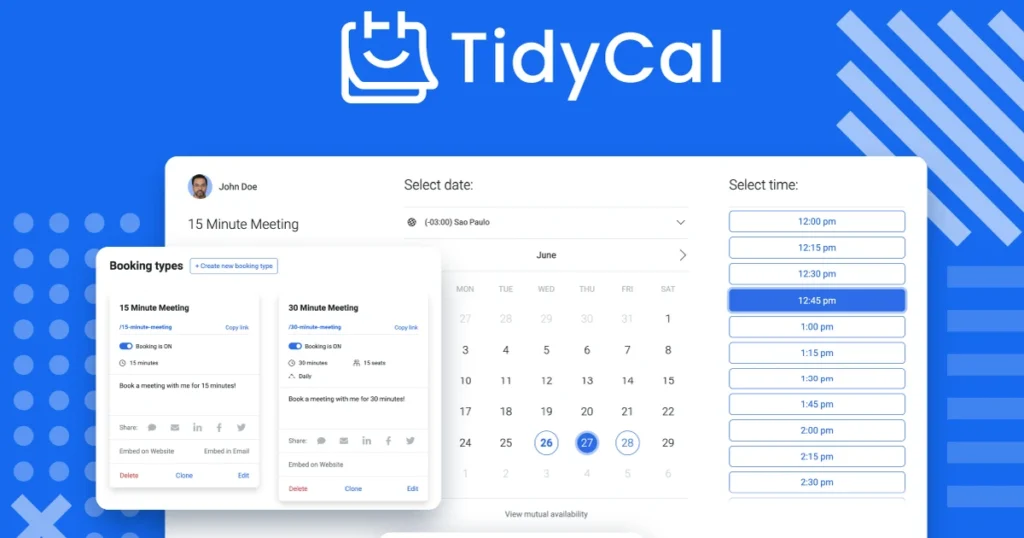
TidyCal is a scheduling tool that became well known through a lifetime-deal offer — a one-time payment instead of an ongoing subscription — rather than the monthly-billing model most competitors use. Checked directly against its own current pricing page, that positioning is still accurate today, and the numbers are more specific than most reviews of it publish.
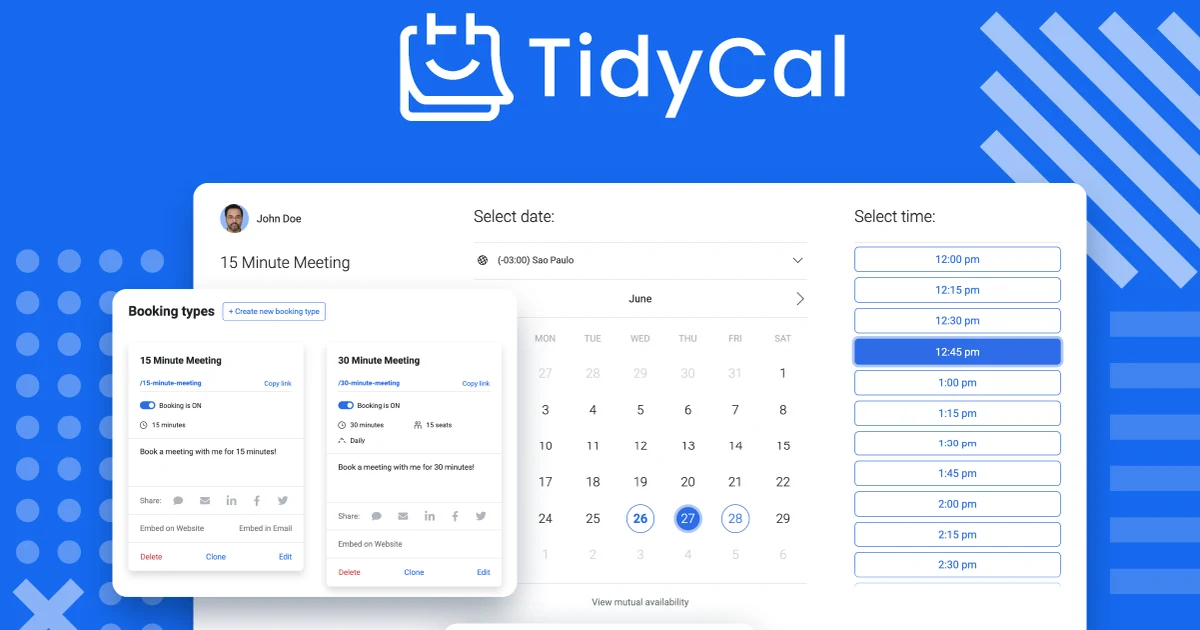
- An AppSumo original that’s run 4+ years with no signs of shutdown — the long-term-risk concern is largely resolved
- Unlimited bookings and booking types at $0 is unusually generous
- No native mobile app — web-based only
- No CRM integration (Salesforce/HubSpot) or booking analytics dashboard
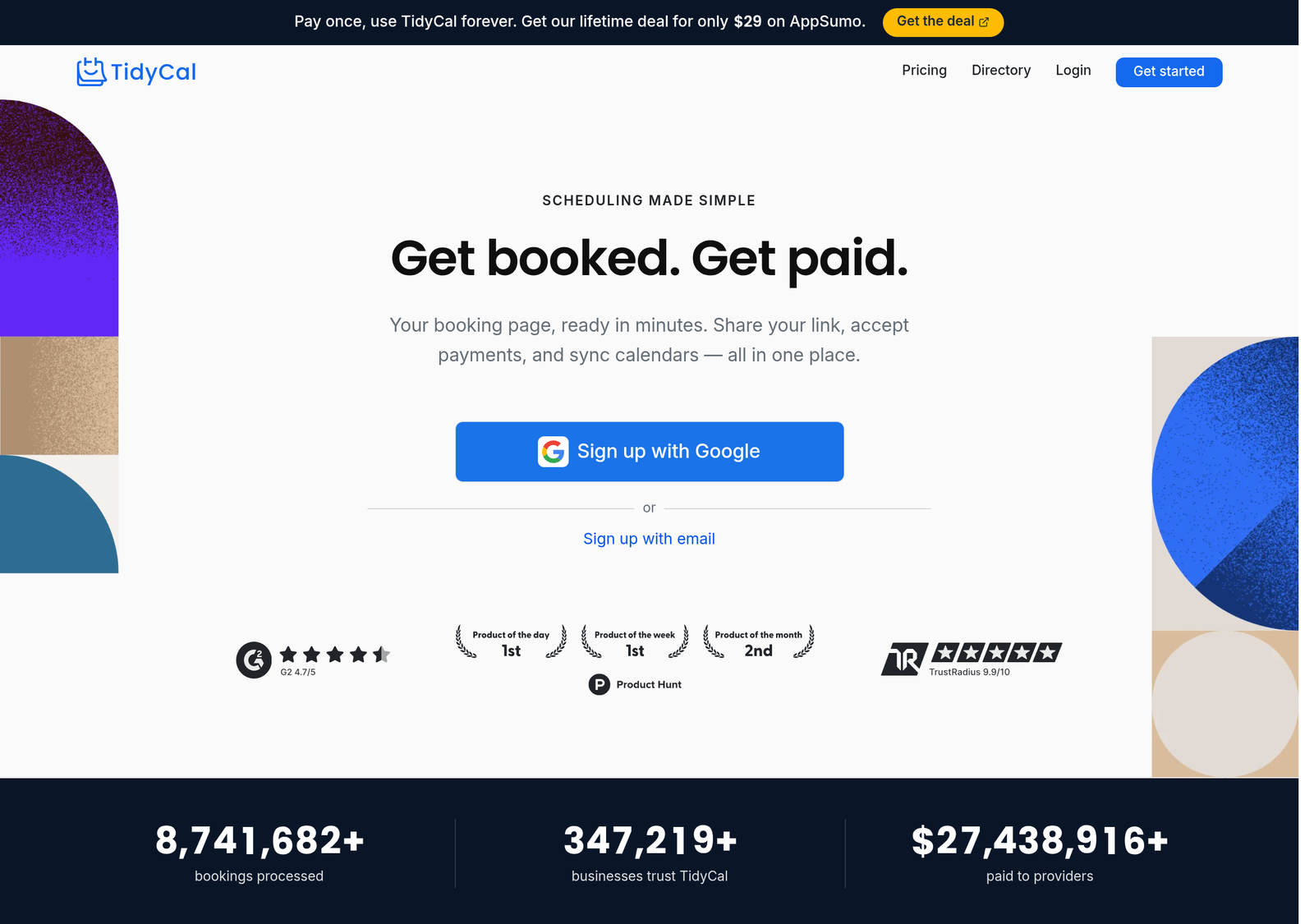
What TidyCal Does
Like Calendly or Cal.com, TidyCal connects to your calendar and generates booking pages and links so others can schedule time with you without an email back-and-forth. Its main differentiator has been pricing structure — a one-time cost as an option, rather than a mandatory recurring subscription.
Real-World Use Cases
- A freelancer on a tight budget uses the free tier’s unlimited bookings and booking types to run all client scheduling at $0, only upgrading if they specifically need video links, group bookings, or analytics later.
- A solo consultant who dislikes recurring bills buys the Individual Lifetime tier at $29 one-time via AppSumo, betting that the product stays maintained long enough for the one-time price to beat years of a subscription competitor.
- An agency managing multiple clients’ scheduling buys the Agency Lifetime tier for its multi-client capability, weighing the lifetime savings against the real risk that feature pace lags Calendly or Cal.com’s subscription tiers.
Current Pricing, Verified
| Plan | Price | What’s included |
|---|---|---|
| Free | $0, forever | Unlimited bookings, booking types, paid bookings, recurring/package bookings, your own booking page |
| Individual Lifetime | $29 one-time (from $144) | Advanced features, sold as a lifetime licence via AppSumo |
| Agency Lifetime | $79 one-time (from $240) | Multi-client/team capability, also a lifetime licence via AppSumo |
| Pro | $12/mo, or $99/yr ($8.25/mo) | Video meeting links, group bookings, AI assistance, analytics, team features — as a standard subscription instead |
The free tier here is genuinely generous — unlimited bookings and booking types at $0 covers a real chunk of what a solo professional needs, which is unusual in a category where competitors often cap free-tier booking volume. The lifetime options sit specifically at AppSumo’s discounted rate, meaningfully below the stated regular price, which is the standard structure for an AppSumo-distributed lifetime deal rather than something unique to TidyCal.
Lifetime Deal Break-Even Calculator
TidyCal’s lifetime tiers are verified above at $29 and $79. Plug in what you’d actually expect to pay monthly for a subscription competitor like Calendly to see when the one-time price pays for itself — this only tells you the math, not whether TidyCal will still be maintained by the time you get there.
Method: break-even = one-time price ÷ your monthly cost, rounded up to the next whole month. Savings = (monthly cost × months) − one-time price; a negative number means the subscription would have cost you less over that period. The subscription figure is yours to set, not a “typical Calendly price” we’re asserting as fact — check current competitor pricing directly. As the section above notes, a lifetime deal only pays off if the vendor keeps the product running and maintained for as long as you’re counting on it.
Lifetime Deals: What to Actually Check
Before buying any "lifetime" software deal, TidyCal included, check these regardless of the specific vendor:
- What "lifetime" actually covers — lifetime access to current features, or lifetime updates too? These are different promises, and vendors aren't always clear about which one you're getting.
- Company stability — a one-time payment only pays off if the company stays operational long enough to deliver ongoing value; check how long the vendor has been running and whether they have a track record of maintaining past lifetime-deal products.
- Feature parity with subscription competitors — lifetime-deal products sometimes lag behind subscription competitors on newer features, since there's less predictable ongoing revenue funding development. TidyCal's own Pro subscription tier existing alongside its lifetime option is worth noting here — it suggests the newest features may land in Pro first.
- Export options — confirm you can export your data and bookings if you ever need to switch tools, regardless of what you paid upfront.
How It Compares to Subscription Alternatives
| TidyCal (lifetime option) | Calendly / Cal.com (subscription) | |
|---|---|---|
| Pricing structure | Free tier, or $29-79 one-time via AppSumo | Monthly or annual subscription |
| Long-term cost | Lower if the product stays useful for years | Adds up over time, but funds ongoing development |
| Feature pace | Typically slower on the lifetime tier specifically | Faster, backed by recurring revenue |
Who It's a Good Fit For
Solo professionals and small businesses on a budget who want core scheduling functionality without a recurring bill are the best fit — and given the free tier's genuine breadth, that covers more people than the "lifetime deal" framing alone suggests. Teams needing cutting-edge features or deep third-party integrations should compare TidyCal's Pro tier and current feature set directly against Calendly and Cal.com before deciding, since the lifetime tiers may not keep pace with either.
Pros and Cons
| Pros | Cons |
|---|---|
| Free tier is genuinely generous — unlimited bookings and booking types, not a capped trial | Lifetime tier's update cadence and long-term maintenance couldn't be independently verified |
| Lifetime pricing removes the recurring bill entirely if the product stays maintained | Feature pace on the lifetime tier is typically slower than a subscription-funded competitor's |
| A standard Pro subscription exists too, for anyone who'd rather not bet on lifetime longevity | Newest features may land in Pro first, ahead of the lifetime tiers |
| Break-even math is genuinely favorable against a monthly competitor if TidyCal lasts years | "Lifetime" only pays off if the company itself stays operational — a real, unhedgeable risk |
Detailed Analysis
The free tier undercuts the lifetime-deal pitch itself
Most lifetime-deal reviews frame the one-time price as the headline value proposition, but TidyCal's free tier is generous enough — unlimited bookings and booking types — that it quietly covers a meaningful share of the audience the lifetime deal is pitched to. Anyone whose needs stop at core scheduling should seriously consider whether they need to pay anything at all before reaching for the $29 or $79 option, rather than assuming the lifetime deal is the default smart move.
The real trade is company risk, not math
The break-even calculator above answers the arithmetic question cleanly, but the arithmetic was never the hard part of a lifetime-deal decision. The real uncertainty is whether TidyCal stays maintained and funded long enough for that arithmetic to play out — a one-time payment removes recurring revenue as a guarantee of continued development, which is precisely why lifetime-tier feature pace tends to lag a subscription product's. Treat the break-even number as a best case that assumes the company survives, not a guarantee.
Our Rating, and How We Reached It
| Criteria | Score | Why |
|---|---|---|
| Free tier value | 9/10 | Unlimited bookings and booking types at $0 is unusually generous for the category. |
| Lifetime deal economics | 7/10 | Genuinely favorable break-even math against a subscription competitor, if the company survives long-term. |
| Long-term risk | 5/10 | Update cadence on the lifetime tier could not be independently verified — a real, unhedgeable uncertainty. |
| Feature competitiveness | 6/10 | Solid core scheduling functionality, but feature pace on lifetime tiers typically trails subscription-funded competitors. |
Overall: 6.75/10. A strong pick for budget-conscious solo professionals who accept the company-survival risk inherent to any lifetime deal; less compelling for teams needing cutting-edge features at pace. Pricing verified directly against TidyCal's own pricing page at the time of writing.
PROOF Score
Overall: 7.2 / 10 — Recommended. Scored under our PROOF methodology — five checkable pillars, not a vibe.
Should You Buy TidyCal?
- Start on Free if your needs are core scheduling only — it's genuinely usable, not a crippled trial.
- Buy the lifetime tier if you want to bet on a one-time cost over years of subscription, and you've checked the vendor's track record for maintaining past lifetime-deal products.
- Buy Pro instead if you'd rather have a standard subscription funding ongoing development than bet on lifetime-tier longevity.
- Skip the lifetime tiers if you need cutting-edge features at pace — compare current feature sets directly against Calendly and Cal.com first.
Frequently Asked Questions
Is the lifetime deal still available?
As of this writing, yes — TidyCal's own pricing page lists both Individual ($29) and Agency ($79) lifetime tiers as current AppSumo offers. Lifetime deals can close without much notice, so confirm current availability directly before assuming this holds.
Is the free plan actually usable, or a crippled trial?
It's a genuine free tier — unlimited bookings and booking types, not a time-limited trial. The paid tiers add features (video links, group bookings, AI assistance, analytics, team support) rather than removing a cap on core usage.
Does TidyCal get regular updates?
We could not independently verify a specific update cadence. Check the changelog or release notes directly on their site for current activity before purchasing, particularly for the lifetime tier where update pace has historically been a real category-wide risk.
Disclosure: some links on this page may be affiliate links. If you purchase through them we may earn a commission at no extra cost to you. Pricing and features change — verify current details directly with the vendor before purchasing.
Alternatives worth comparing