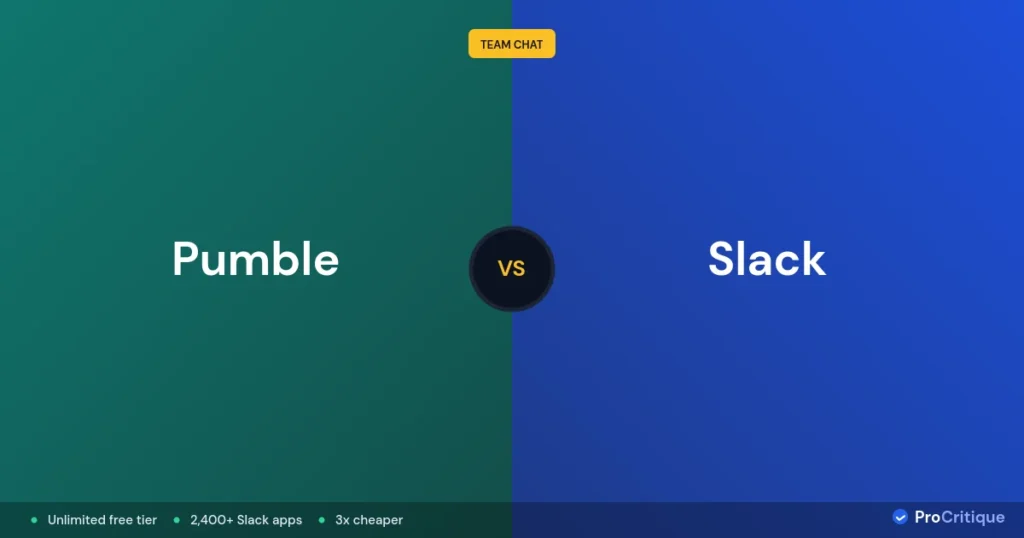
One line: Pumble wins on price and free-tier generosity; Slack wins on integration depth and enterprise-grade reliability guarantees.
Both are Slack-style team chat apps in the literal sense — channels, threads, direct messages, calls. The decision between them comes down to what you’re actually optimizing for: the lowest cost for a small team that mostly needs to talk to itself, or the deepest ecosystem for a team that needs to connect chat to a dozen other tools.
Who Should Pick Which
Which one should you pick?
Answer a couple of quick questions using the same factors covered below.
Does your team rely on connecting chat to lots of other tools — CRM, dev tools, niche apps?
Do you need SSO, compliance controls, or a contractual uptime guarantee for procurement reasons?
Do frequent group video calls matter, or mostly 1:1 calls and text?
Slack
Slack’s app marketplace is genuinely bigger and deeper than Pumble’s — hundreds of integrations against a still-limited list. If your workflow depends on a specific niche tool talking to chat, check Slack’s directory first.
Slack (Business+)
Slack’s Business+ tier adds SAML SSO, SCIM provisioning, data-residency options, and a contractual 99.99% uptime guarantee. Pumble doesn’t publish an equivalent enterprise compliance tier — if procurement needs this paperwork, Slack clears it and Pumble doesn’t.
Pumble Pro or Business
Pumble’s free tier only supports 1:1 calls — group video needs Pro (up to 50 people) or Business (up to 100). Still meaningfully cheaper than Slack at the equivalent tier, but budget for the upgrade if group video is a daily habit.
Pumble Free
Unlimited message history, unlimited users, 10 GB storage, 24/7 human support — all on the free tier. This is exactly the profile Pumble’s free plan is built for, and it costs nothing.
- Pick Pumble if you’re a small or mid-size team that wants Slack-style chat without Slack-style per-seat cost, and you don’t lean heavily on group video or niche integrations.
- Pick Slack if you need deep third-party integrations, enterprise compliance controls, or a contractual uptime guarantee your procurement process requires.
Spec Comparison
| Pumble | Slack | |
|---|---|---|
| Free tier message history | Unlimited | 90 days |
| Free tier storage | 10 GB total | 5 GB |
| Free tier support | 24/7 human support | Standard business hours |
| Paid entry price | $2.49/user/mo (annual) | $7.25/user/mo (annual) |
| Top tier | Enterprise, $6.99/user/mo | Business+, $15/user/mo |
| Group video | Pro tier and up (50-100 people) | Pro tier and up (huddles) |
| Third-party integrations | Limited, even on paid tiers | Extensive marketplace |
| Uptime guarantee | Not published | 99.99%, contractual on Business+ |
| Cross-company channels | Not a named feature | Slack Connect |
Where They Actually Differ
The free tier isn’t close
This is the single biggest differentiator, and it isn’t subtle. Pumble’s free plan keeps unlimited message history and unlimited users at zero cost, plus 10 GB of shared storage. Slack’s free tier caps history at 90 days and storage at 5 GB — it behaves like an extended trial more than a permanent product. For a small team on a real budget, this alone is worth trying Pumble before assuming Slack is the default choice.
Price at every paid tier
Pumble’s Pro tier runs $2.49/user/month annually against Slack’s Pro at $7.25 — roughly a third of the cost for a broadly comparable feature set. At the top end, Pumble’s Enterprise tier is $6.99/user/month against Slack’s Business+ at $15. Pumble’s own materials estimate a 25-person Business-tier workspace at roughly $75/month versus a comparable Slack setup around $220/month — treat the exact multiplier as a vendor claim, but the underlying per-seat math checks out against each company’s own published pricing.
Integrations: Slack’s real advantage
Slack’s app marketplace lists over 2,400 verified integrations, spanning CRM, dev tools, and niche business software. Pumble’s integration list stays limited even on its top tier, and multiple reviewers flag this specifically as a real gap, not a minor inconvenience — tools like Salesforce, Jira, or PagerDuty may not have a native Pumble connection at all. If your team’s workflow depends on chat talking to a specific tool, check Pumble’s directory before assuming it’s covered.
Reliability: neither is bulletproof, but differently
Independent status monitoring has recorded 32+ incidents on Pumble’s web app over roughly two years, and multiple reviewers separately report video calls failing to connect on the first attempt. Slack isn’t immune either — independent tracking shows Slack averaging around 99.04% availability with real recent incidents, including a 16-hour warning-level event in September 2026, and over 2,600 tracked outages across its history as a distributed platform serving a vastly larger user base. The real difference isn’t “one is reliable and one isn’t” — it’s that Slack’s Business+ tier backs its uptime with a contractual 99.99% guarantee, which Pumble doesn’t publish an equivalent for.
Enterprise compliance: a real gate for some buyers
Slack’s Business+ tier adds SAML-based SSO, SCIM provisioning, and data-residency options — real procurement checkboxes for regulated industries or larger organizations. Pumble’s Enterprise tier adds SSO and data retention controls too, but doesn’t carry the same depth of compliance documentation Slack publishes. For a small team this rarely matters. For an enterprise vendor-approval process, it can decide the comparison before price is even discussed.
A Concrete Scenario
A 12-person bootstrapped startup, mostly async text communication with occasional 1:1 calls, no CRM or dev-tool integration needs yet. Pumble Free covers this completely — unlimited history, unlimited users, no per-seat cost, and 24/7 support if something goes wrong. The same team on Slack would either live inside the 90-day history limit or need to upgrade to Pro at $7.25/user/month for a feature Pumble includes free.
Now take a 40-person company already running Salesforce, a suite of dev tools, and an IT team that requires SSO for any new software. Pumble’s integration list won’t reach far enough into that stack, and its enterprise tier doesn’t carry Slack’s compliance depth. Slack Business+ is built for exactly this profile, and the per-seat premium buys real, specific capability this team actually needs.
Frequently Asked Questions
Is Pumble actually free forever, or is it a limited trial?
Genuinely free and ongoing — unlimited users and unlimited message history on the free tier, with no time-based expiration. The upgrade triggers are group call size and integration count, not a countdown on your history.
Can I migrate my Slack history to Pumble?
Pumble supports importing from Slack, though the completeness of message and file history transferred can vary — check Pumble’s current import documentation directly before assuming a full, lossless migration.
Which one is more reliable?
Both have real, documented outage history — Pumble more frequently in absolute incident count over the past two years, Slack backing its top tier with a contractual 99.99% guarantee that Pumble doesn’t match. Neither should be assumed bulletproof.
Does Pumble support video calls?
Yes — 1:1 calls are included free. Group video (up to 50 people on Pro, 100 on Business) requires a paid tier.
Is Slack worth the price premium for a small team?
Usually not, unless your team specifically needs Slack’s integration depth or enterprise compliance features today. For pure chat-and-calls use, Pumble’s free tier covers what most small teams actually need.
Final Decision
Best for:
- Pumble: Small to mid-size teams prioritizing cost and a genuinely unlimited free tier
- Slack: Teams needing deep integrations, enterprise compliance, or a contractual uptime guarantee
Avoid if:
- Pumble: your workflow depends on niche third-party integrations, or frequent large group video calls on a budget
- Slack: you’re a small team that would be paying enterprise-grade pricing for features you won’t use
Bottom line:
Pumble makes the strongest case of any team-chat app in its category for teams that just need reliable channels and calls without per-seat cost creeping up. Slack’s premium buys a real, deeper ecosystem — the question is whether your team actually needs that depth today, or is paying for headroom it won’t use for years.
How We Assessed This
Pumble’s figures are drawn from our own Pumble review and Pumble’s current published pricing. Slack’s figures reflect Slack’s own current published pricing and independent uptime-monitoring data, checked directly as of September 2026. Disclosure: this page contains no affiliate link for Slack; the Pumble link on this page may be an affiliate link.
Related