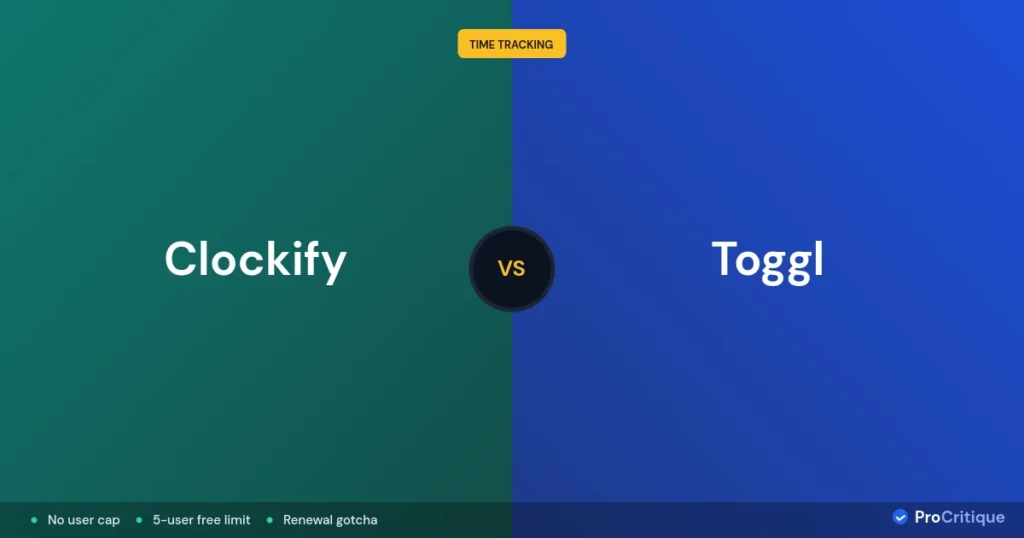
One line: Clockify wins on the free tier — unlimited users, unlimited projects, genuinely free forever. Toggl’s free plan caps out at 5 users, and its Premium tier carries a renewal increase worth knowing about before you commit annually.
Both are time-tracking tools solving the same core problem — knowing where billable hours actually went. The decision mostly comes down to team size and whether Toggl’s more polished reporting is worth paying for sooner than Clockify would ask you to.
Who Should Pick Which
- Pick Clockify if you have more than 5 people who need to track time, or you simply don’t want a user-count ceiling forcing an upgrade decision before you’re ready for one.
- Pick Toggl if your team is 5 people or fewer, and you’d rather pay for more polished reporting and integrations sooner than wait for Clockify’s paid tiers to unlock them.
Spec Comparison
| Clockify | Toggl Track | |
|---|---|---|
| Free tier user limit | Unlimited | 5 users |
| Free tier tracking/projects | Unlimited | Unlimited (within the 5-user cap) |
| Paid entry price | $3.99/seat/mo (Basic, annual) | $9/seat/mo (Starter, annual) |
| Mid tier | $5.49/seat/mo (Standard) — invoicing, approvals | $18/seat/mo (Premium, standard annual rate) |
| Renewal gotcha | None documented | Premium’s promotional annual rate is $14 the first year, renewing at $18 — a 29% increase |
| GPS tracking | Pro tier | Not a core feature |
| Mobile app quality | Weakest part of the product, per our review | Generally well-regarded |
Where They Actually Differ
The free-tier ceiling is the whole decision for most teams
Clockify’s free plan has no user limit at all — a 20-person team tracks time at zero cost, same as a freelancer. Toggl’s free plan caps at 5 users. Add a sixth person and you’re paying, full stop. For any team larger than a small handful, this alone settles the comparison before price or features enter the conversation.
Toggl’s renewal pricing has a real gotcha
Toggl’s Premium tier advertises $14/user/month on annual billing — but that’s a first-year promotional rate. It renews at the standard $18/user/month, a 29% jump that arrives quietly twelve months in if you’re not tracking it. Clockify’s pricing page doesn’t carry an equivalent documented renewal increase. If you’re comparing headline annual prices, check whether the number you’re looking at is a first-year promo or a standing rate.
Reporting polish vs. price
Toggl is generally regarded as having more polished, visually refined reporting and a smoother mobile experience — our own Clockify review flags Clockify’s mobile app specifically as the product’s weakest part, prone to sync lag and occasional duplicate entries. If reporting quality and mobile reliability matter more to your team than raw cost, that’s a real point in Toggl’s favor worth paying for.
Feature-gating philosophy differs
Clockify gates invoicing behind Standard and budget/forecasting behind Pro — a fairly standard progression. Toggl’s paid tiers focus more on advanced reporting, project templates, and integrations rather than a single standout gated feature. Neither approach is wrong; it depends whether your team’s next real need is billing workflow (Clockify’s paid path) or deeper analytics (Toggl’s).
A Concrete Scenario
A 12-person agency tracking billable hours across multiple clients hits Toggl’s 5-user free cap immediately — Clockify covers the same team at zero cost until a specific paid feature (invoicing, budgets) becomes the actual reason to upgrade, not team size itself.
A 3-person freelance collective that values sleek reporting and doesn’t mind paying a modest per-seat fee from the start might prefer Toggl’s Starter tier ($9/seat/mo annual) for the reporting polish, since team size was never going to force an upgrade on Clockify either way.
Frequently Asked Questions
Is Clockify’s free plan actually unlimited, or is there a hidden cap?
Based on its own published pricing, unlimited users, projects, and tracked time are included on Free with no documented ceiling — the upgrade trigger is a specific paid feature (invoicing, GPS tracking, budgets), not usage volume or team size.
Why does Toggl cap its free plan at 5 users?
That’s simply how Toggl structures its free tier — a small-team allowance rather than an unlimited one. It’s a real, documented limit worth checking against your actual team size before assuming “free” applies to you.
Will my Toggl bill jump after the first year?
On the Premium tier’s annual plan, yes — the $14/user/month promotional rate renews at the standard $18/user/month after the first year, a real increase to budget for rather than be surprised by.
Which has better mobile apps?
Toggl’s mobile experience is generally better regarded. Our own Clockify review specifically flags Clockify’s mobile app as its weakest component, with sync lag that can create duplicate time entries.
Can I switch from Toggl to Clockify without losing my time history?
Both platforms support data export, and migration is generally straightforward for time-entry data specifically, though exact import fidelity can vary — check each platform’s current import documentation before a full switch.
How We Assessed This
Clockify’s figures are drawn from our own Clockify review and Clockify’s current published pricing. Toggl’s figures reflect Toggl’s own current published pricing, checked directly as of September 2026. Disclosure: the Clockify link on this page may be an affiliate link; this page contains no affiliate link for Toggl.
Related