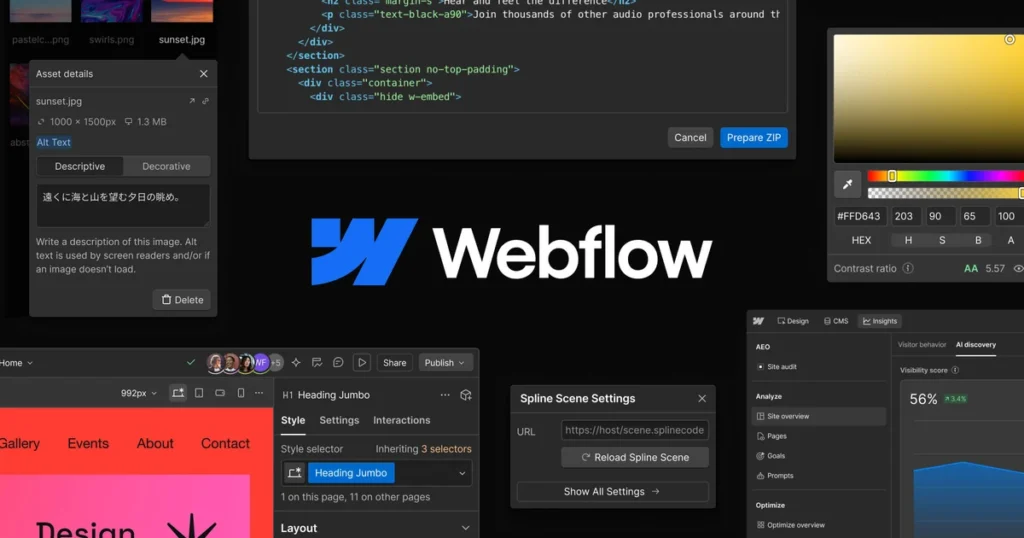
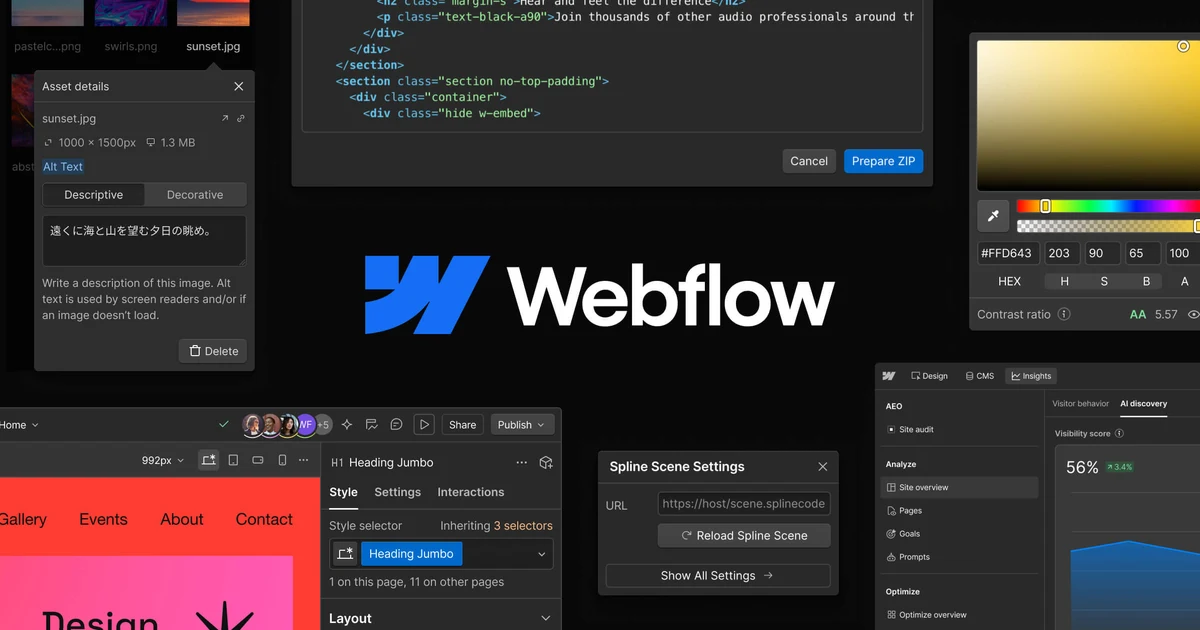
Webflow is a visual development tool, not a website builder in the Squarespace sense. You design on a canvas, but what you’re manipulating is the actual CSS box model — flexbox, grid, positioning, class inheritance — and the output is real HTML, CSS and JavaScript. That makes it far more capable than template-based builders and considerably harder to learn.
Two things have changed recently and most reviews haven’t caught up: Webflow restructured its pricing in May 2026, and Framer has become a serious competitor for the projects Webflow used to win by default. Both change the buying decision.
Executive Answer
Choose Webflow if you understand how CSS layout works — or are willing to learn — and you need genuine design freedom on a content-driven site. Its CMS is the most capable in the visual-builder category, and for directories, editorial sites and marketing sites with real content structure, nothing else in this class matches it.
Don’t choose it if you want a site finished this afternoon, if margin and padding mean nothing to you, or if you’re building a portfolio or landing page — Framer will get you there faster and cheaper.
Quick Verdict
| Category | Verdict |
|---|---|
| Best for | Designers with CSS knowledge, agencies building marketing sites, content-heavy sites and directories |
| Not ideal for | Complete beginners, simple portfolios, anyone needing a site today |
| Biggest strength | Design freedom with a genuinely capable CMS behind it |
| Biggest weakness | Steep learning curve, and costs that stack across sites and seats |
| Entry price | Free Starter plan; Basic from $15/month billed yearly |
| Main rival | Framer for design-led sites; WordPress for extensibility |
| Overall | Recommended for the right project and the right person — not a general-purpose builder |
- Best visual design control in its class
- Strong CMS depth compared to rivals like Framer
- Steep learning curve is the defining barrier for most buyers
- Costs stack up quickly once seats and sites multiply
The Learning Curve Is the Whole Story
Almost every complaint about Webflow is really about this. If you already understand CSS, Webflow feels like a fast, visual way to do what you were doing by hand, and the class system makes immediate sense. If you don’t, you’re effectively learning CSS through an unfamiliar interface, and the first few days are genuinely frustrating.
Reviewers consistently describe the curve as steeper at the start than over the long run — the concepts click, and then building becomes intuitive. That’s an accurate description, but “it gets easier after the hard part” is not much comfort if you needed a site launched this week.
Webflow University, the company’s free course library, is unusually good and largely exists to close this gap. If you’re evaluating Webflow, spend an evening there before paying for anything. It will tell you quickly whether this is a tool you’ll enjoy or fight.
The New Pricing, Explained
Webflow reorganised its plans in May 2026, merging the old CMS and Business site plans into a single Premium plan. If you’re reading older reviews quoting a “$23 CMS plan” and a “$39 Business plan,” those no longer exist as separate tiers.
| Site plan | Price (billed yearly) | What it covers |
|---|---|---|
| Starter | Free | Testing and learning, on a webflow.io subdomain |
| Basic | $15/month | Static sites with a custom domain — no CMS |
| Premium | $25/month ($39 billed monthly) | 300 static pages, 20,000 CMS items, 40 Collections, 50 GB bandwidth, site search, code components |
| Team | $2,500/month, annual contract | Enterprise bundle: 100 CMS Collections, 10 seats, localisation |
Separately, Workspace seats are billed per person: roughly $39/month for a full seat and $15/month for a content-editor seat. This is the part that surprises people. Site plans and seat plans are two different subscriptions, and they add up independently.
A note on sourcing: Webflow’s own pricing page could not be retrieved directly when this review was researched, so these figures come from multiple independent sources reporting the May 2026 restructure. They agree with each other, but check Webflow’s pricing page before budgeting.
The Stacking Problem
The single most common Webflow complaint isn’t any individual price — it’s how they compound. One site plan, plus a seat for you, plus a seat for a collaborator, plus a second client site, and the monthly total looks nothing like the $15 that drew you in.
Webflow stacked cost calculator
Site plans and seats bill separately. See the real monthly total.
Method: site plan price × number of sites, plus seats charged per person per month. Seat prices are approximate published figures and Webflow’s plan structure changed in May 2026 — verify current pricing before committing. Excludes bandwidth add-ons, ecommerce plans, localisation, and taxes.
The lesson the calculator teaches quickly: in small teams, seats often cost more than hosting. If a client only needs to edit blog posts, put them on a content-editor seat rather than a full one.
The CMS Is the Real Differentiator
Webflow’s CMS lets you define Collections with typed fields and bind them to visual templates — a blog, a directory, a case-study library, a job board. The Premium plan carries 20,000 CMS items and 40 Collections, which is far beyond what most marketing sites need.
This is what separates Webflow from design-first tools. For a site whose value is structured content rather than a single beautiful page, the CMS is the reason to be here. It is not, however, a WordPress replacement in extensibility terms: there is no plugin ecosystem of comparable depth, and application logic isn’t what it’s for.
How Long It Actually Takes to Build Something
Reviews rarely put numbers on the learning curve, so here is a realistic shape of it, drawn from how consistently the same pattern appears in user accounts rather than from any single measurement.
The first day is the hard one. Nothing sits where you expect, and elements move in ways that seem arbitrary until you realise the canvas is enforcing real CSS rules rather than absolute positioning. People who quit Webflow almost always quit here.
The turning point is understanding classes. Once you grasp that a class is a reusable style you attach to elements — and that changing it changes everything wearing it — the tool stops feeling arbitrary and starts feeling fast. Most accounts put that moment somewhere in the first week of real use.
After that, the constraint shifts from the tool to your design skill. Webflow will build whatever you can specify; it just won’t decide what good looks like for you. That’s the honest difference from Squarespace, which makes those decisions on your behalf through templates.
Budget a week before judging it. Evaluating Webflow in an afternoon reliably produces the wrong answer.
Where Webflow Falls Short
Ecommerce Is Thin
Webflow’s commerce features lag the specialists. Multi-currency support is limited and there’s no native subscription billing. For a small catalogue of simple products it works; for a serious store, Shopify or WooCommerce are better tools and it isn’t close.
Non-Developers Often Need Help
A recurring theme in reviews: businesses buy Webflow, discover they can’t operate it, and hire an agency. That’s not a failure of the product so much as a mismatch of expectations — but if you’re a small business owner choosing between Webflow and Squarespace, this is the most important sentence in this review.
Export Doesn’t Take the CMS
Static code export is available on some plans, which limits lock-in for simple sites. But exported code doesn’t include CMS content or Webflow-hosted functionality, so a content-driven site is not meaningfully portable. Treat leaving as a rebuild.
Webflow vs. the Alternatives
| Webflow | Framer | Squarespace | WordPress | |
|---|---|---|---|---|
| Entry price | Free / $15 mo | Free tier available | $16/mo yearly | Hosting cost only |
| Design freedom | Very high | High | Template-bounded | Theme-dependent |
| Learning curve | Steep | Moderate | Gentle | Moderate |
| CMS depth | Strong — 20,000 items | Adequate | Basic | Very strong |
| Ecommerce | Weak | Weak | Good | Very strong (WooCommerce) |
| Extensibility | Limited | Limited | Limited | Very high |
| Portability | Static export only | Limited | Rebuild required | Fully portable |
| Main limitation | Learning curve, stacked costs | Less CMS depth | Design ceiling | You maintain it |
Why the differences matter:
- Against Framer: this is the live question in 2026. Framer is faster to learn, simpler to price, and produces polished results quickly — better for portfolios, landing pages and marketing sites. Webflow pulls ahead on content-heavy projects: directories with thousands of entries, editorial sites with multiple authors, anything where CMS structure carries the weight.
- Against Squarespace: a straight trade of freedom for ease, covered in full in our Webflow vs Squarespace comparison. If you have no design background, Squarespace produces a better-looking result faster. If you have a specific design and want it exactly, Squarespace will fight you.
- Against WordPress: Webflow wins on design workflow and on not maintaining software. WordPress wins decisively on extensibility, ecommerce and portability.
Our Rating, and How We Reached It
Based on Webflow’s documented feature set, multiple independent reports of the May 2026 pricing restructure, and aggregated user reviews, as of August 2026. Webflow’s official pricing page could not be retrieved directly during research, so pricing figures carry more uncertainty than usual. No first-hand build testing was performed for this review.
| Criterion | Weight | Assessment |
|---|---|---|
| Design capability | 25% | Excellent — the best visual control in its class |
| CMS depth | 20% | Strong — the main reason to pick it over Framer |
| Ease of learning | 20% | Weak — the defining barrier for most buyers |
| Value for money | 15% | Fair — reasonable per site, poor once seats stack |
| Ecommerce | 10% | Weak — outclassed by dedicated platforms |
| Portability | 10% | Weak — static export only, CMS content stays behind |
Limitations of this scoring: ease of learning is weighted heavily because it is the most common cause of regret. A working designer who already knows CSS should discount that criterion sharply and would rate Webflow considerably higher.
PROOF Score
Overall: 6.0 / 10 — Conditional. Scored under our PROOF methodology — five checkable pillars, not a vibe.
Frequently Asked Questions
Do I need to know how to code?
Not to write it — but understanding how CSS layout works is the difference between Webflow feeling powerful and feeling impossible.
What happened to the CMS and Business plans?
They were merged into a single Premium site plan in May 2026. Reviews quoting them separately are out of date.
Can I export my site?
Static code export is available on some plans. CMS content and Webflow-hosted functionality don’t come with it.
Why is my bill higher than the advertised price?
Site plans and Workspace seats bill separately. Each full seat is around $39/month on top of hosting.
Is Webflow good for ecommerce?
For a small, simple catalogue, adequately. Multi-currency is limited and there’s no native subscription billing, so serious stores should look elsewhere.
Webflow or Framer?
Framer for portfolios, landing pages and design-led marketing sites. Webflow for content-heavy sites, directories and anything needing real CMS structure.
Is there a free plan?
Yes — Starter, on a webflow.io subdomain. Fine for learning and prototyping, not for a live site on your own domain.
Should You Use Webflow?
Choose it if:
- You understand CSS layout, or you’re genuinely willing to learn it
- Your site is content-driven and needs real CMS structure
- You’re a designer or agency who wants production output without a developer
- A template-shaped site would undercut your positioning
Avoid it if:
- You need a site live this week with no design input
- You’re building a serious online store
- You’re a small business owner who won’t have time to learn the tool
- You expect to migrate the site elsewhere later
Best alternative if:
- You want design-led and simpler: Framer
- You want good-looking with no learning curve: Squarespace
- You need extensibility or ecommerce: WordPress
Best plan for most users:
Premium at $25/month billed yearly, with one full seat. Basic saves ten dollars but has no CMS, and most people discover they want a blog within a month of launching.
Best option for advanced users:
Premium site plans per client site, with collaborators on content-editor seats rather than full seats. That one decision is usually the largest available saving on a Webflow bill.
Bottom line:
Webflow remains the most capable visual development tool available, and its CMS is what keeps it ahead of newer design-led rivals. But it asks something of you first: a real understanding of how web layout works. Spend an evening in Webflow University before you spend anything else. If the concepts land, it’s an excellent tool. If they don’t, Framer or Squarespace will make you happier and poorer by less.
Webflow restructured its plans in May 2026 and pricing may change again. Verify current figures on Webflow’s own pricing page before purchasing.
Disclosure: some links on this page may be affiliate links. If you purchase through them we may earn a commission at no extra cost to you. This does not affect our editorial recommendations.
Related
- Migrating Off Wix, Squarespace, or Webflow: What Transfers
- Best Website Builders 2026: Building a Site vs. Building an App
Compare with a popular alternative
Free plan; Basic from $15/month
Stronger at: Genuine design freedom with the most capable CMS in the visual-builder category
Main limitation: Steep learning curve, and costs stack across sites and seats
From $16/month annual
Stronger at: A professional-looking site far faster, with no design skill required
Main limitation: Template-bounded design and a fixed feature list
Alternatives worth comparing