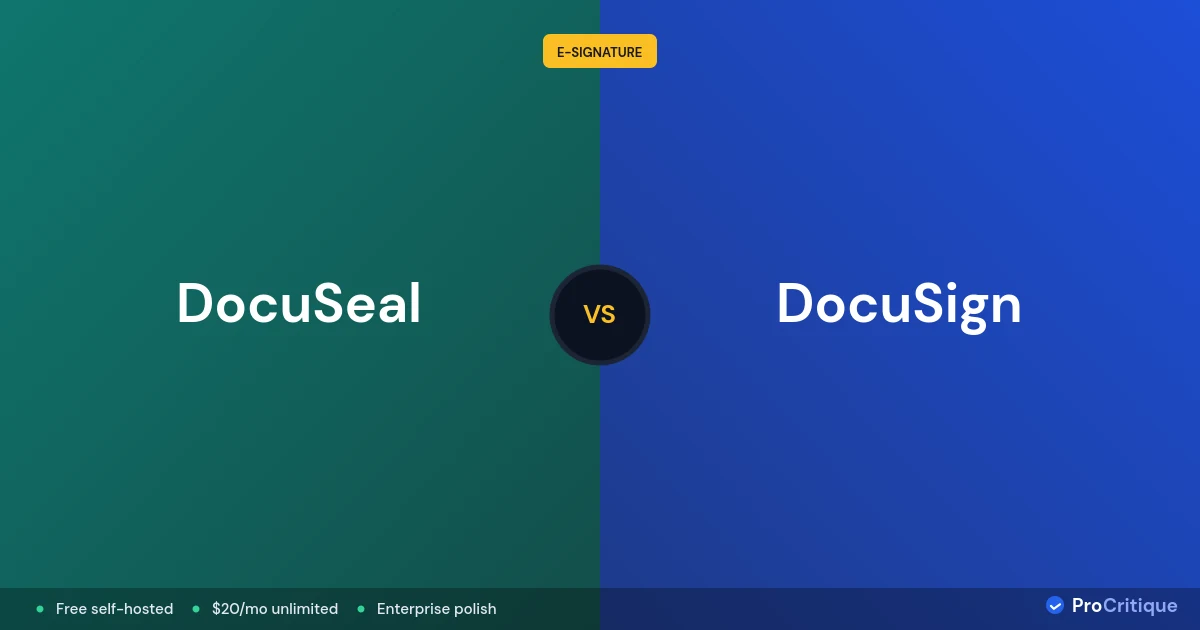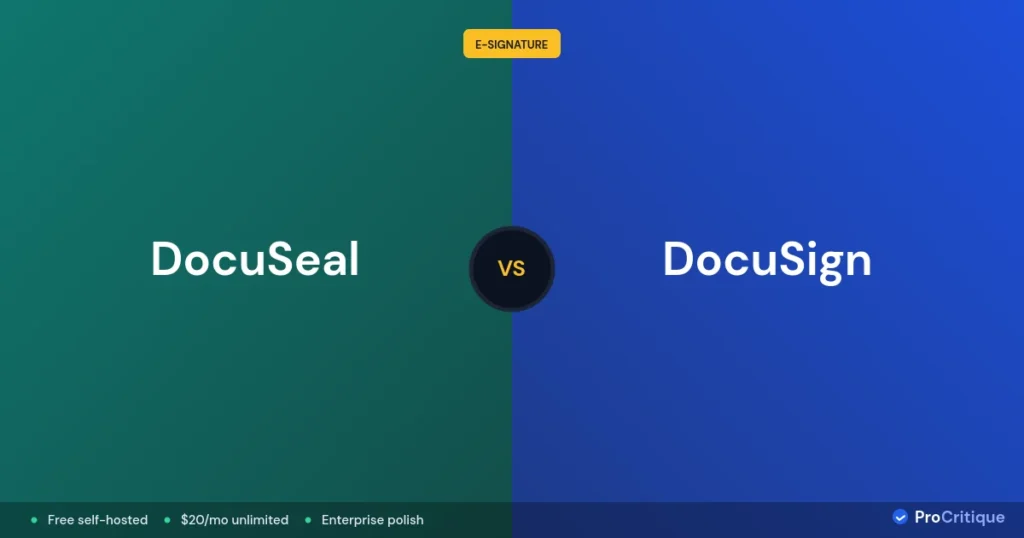
One line: DocuSeal wins on cost — a genuinely usable free tier, plus a self-hosted option that’s free and unlimited. DocuSign wins on polish, integration breadth, and enterprise compliance depth.
DocuSeal launched in 2023 specifically because its founder thought DocuSign was overpriced for what most people actually need. Two years on, it’s a real, credible alternative for a specific kind of buyer — not a like-for-like replacement for every DocuSign use case.
Who Should Pick Which
- Pick DocuSeal if you’re a developer or technical team embedding signing into a product. It also fits an SMB sending a moderate volume of documents monthly, or anyone who wants to drop per-envelope fees entirely by self-hosting.
- Pick DocuSign if you’re a larger organization with a dedicated ops or legal function. It fits high-volume agreements running through Salesforce, where you need the deepest integrations and the most detailed audit trail available.
Spec Comparison
| DocuSeal | DocuSign | |
|---|---|---|
| Free tier | Yes — 10 signature requests/month, core features | Limited free trial only |
| Paid entry price | $20/user/month (unlimited requests) | $15-$65/user/month depending on tier |
| Self-hosted option | Yes — free and open source, unlimited use | No |
| Founded | 2023 | 2003 |
| Third-party integrations | 9 native integrations (Zapier, Microsoft 365, Google Drive, Salesforce) | 24 native integrations |
| Legal validity | ESIGN, UETA, eIDAS compliant | ESIGN, UETA compliant, plus deeper enterprise compliance certifications |
| Audit trail depth | Basic audit log | More sophisticated, enterprise-grade evidence summaries |
Where They Actually Differ
The self-hosting option is the real differentiator
DocuSeal is open source, and its self-hosted version is free and unlimited — you run it on your own infrastructure and pay only for that hosting, not a per-user or per-envelope fee. For a technical team comfortable managing another service, this genuinely changes the cost equation at scale. DocuSign has no self-hosted option, so it has no real answer to this at all.
Feature parity on signing, gap on polish and depth
Look at the core signing workflow feature-by-feature — multiple signers, various field types, legally binding signatures. DocuSeal is genuinely equivalent to DocuSign there. Where DocuSign pulls ahead: signer-facing polish, which matters for client-facing documents where the experience reflects on your business. A considerably larger integration catalog. And audit-trail sophistication that approaches formal legal-evidence standards, rather than a basic log.
Pricing structure rewards different usage patterns
DocuSign’s $15-65/user/month scales with tier and feature depth. DocuSeal’s cloud Pro is a flat $20/user/month for unlimited requests. That’s simpler, and often cheaper at moderate-to-high volume, because it isn’t metered per envelope the way some competitors are. The free tier’s 10-requests-per-month cap is real and will feel tight fast for anything beyond occasional use, but it’s a genuinely usable free tier, not a crippled trial.
What “Open Source” Actually Means Here
DocuSeal publishes its code openly. Anyone can inspect it, run it, or change it. Self-hosting means you install DocuSeal on your own server instead of paying for their cloud version. You get the same signing tool. You just run it yourself. That trade brings real work with it: you handle updates, backups, and uptime. In exchange, you never pay a per-user fee again.
A Concrete Scenario
A small agency sending 20-30 contracts a month can run DocuSeal’s open-source version instead, if they’re comfortable with basic self-hosting. It costs whatever a modest server costs to run. There’s no per-user or per-envelope fee at all. A 200-person company running signature workflows through Salesforce is a different case entirely. Its legal team needs enterprise-grade audit trails. DocuSign’s integration depth and compliance certifications are built for exactly that scale. DocuSeal doesn’t yet match it.
Frequently Asked Questions
Is DocuSeal actually free, or is that a limited trial?
The cloud free tier is genuinely ongoing, capped at 10 signature requests per month rather than time-limited. The self-hosted open-source version has no request cap at all — you’re limited only by your own infrastructure.
Is DocuSeal legally binding like DocuSign?
Yes — both produce signatures compliant with ESIGN and UETA. DocuSeal also supports eIDAS for EU compliance. The gap isn’t legal validity, it’s audit-trail sophistication for high-stakes enterprise disputes specifically.
Can I self-host DocuSeal for a team of any size?
Yes — the open-source version has no built-in user limit. Your practical constraint is your own server’s capacity, not a licensing cap from DocuSeal.
Why would anyone pay for DocuSign if DocuSeal is cheaper?
Integration breadth and audit-trail depth are the real reasons. Two kinds of company get real value from DocuSign that DocuSeal doesn’t yet fully replicate: one already deeply embedded in Salesforce workflows, and one that needs enterprise-grade legal evidence summaries.
Does DocuSeal support the same field types as DocuSign?
Yes — both offer a comparable range of field types (text, signature, date, checkbox, initials, and others), with DocuSeal matching DocuSign’s core signing-workflow feature set closely.
Final Decision
Best for:
- DocuSeal: Technical teams, SMBs, and anyone wanting to eliminate per-envelope costs via self-hosting
- DocuSign: Larger organizations needing deep Salesforce/enterprise integration and audit-trail sophistication
Avoid if:
- DocuSeal: you need the largest possible integration catalog or the most polished signer experience available today
- DocuSign: you’re cost-sensitive and don’t need enterprise-grade compliance depth — you’d be paying for capability you won’t use
Bottom line:
DocuSeal earned its place as a real DocuSign alternative faster than most open-source challengers do, specifically because the core signing workflow is genuinely equivalent. The decision comes down to whether you need DocuSign’s integration depth and audit sophistication badly enough to pay considerably more for it.
How We Assessed This
DocuSeal’s figures are drawn from our own DocuSeal review and DocuSeal’s current published pricing, verified directly. DocuSign’s figures reflect DocuSign’s own current published pricing and third-party G2 ratings, checked as of September 2026. Disclosure: the DocuSeal link on this page may be an affiliate link; this page contains no affiliate link for DocuSign.
Related