Executive answer: Capsule CRM is a contact and sales-pipeline management tool with a genuinely usable free tier: 250 contacts, 2 users, one sales pipeline. A small consulting practice can run on that free tier until it outgrows either limit. It’s a good fit for a small team that wants straightforward pipeline tracking without the configuration overhead of an enterprise CRM like Salesforce.
Quick Verdict
| Best for | Small teams and consultancies wanting straightforward contact and pipeline tracking without enterprise CRM complexity |
| Not ideal for | Larger sales organisations needing complex multi-stage automation or deep third-party integration depth |
| Biggest strength | A real free tier — 250 contacts, 2 users — not a 14-day trial disguised as free |
| Biggest weakness | No phone or live chat support on every plan, and reporting is limited for teams wanting custom dashboards |
| Value for money | Strong at Free and Starter for a small team’s actual needs |
| Overall | Recommended for small teams wanting straightforward pipeline tracking without enterprise CRM overhead |

- Interface stays out of the way — praised for fast onboarding by numerous reviewers
- Starter and Growth pricing confirmed directly against Capsule’s own live pricing page
- No phone or live chat support on every plan — a real, sourced gap, not a fabricated one
- Reporting is fine for basics but frustrating for teams wanting custom dashboards
What Capsule CRM Actually Is
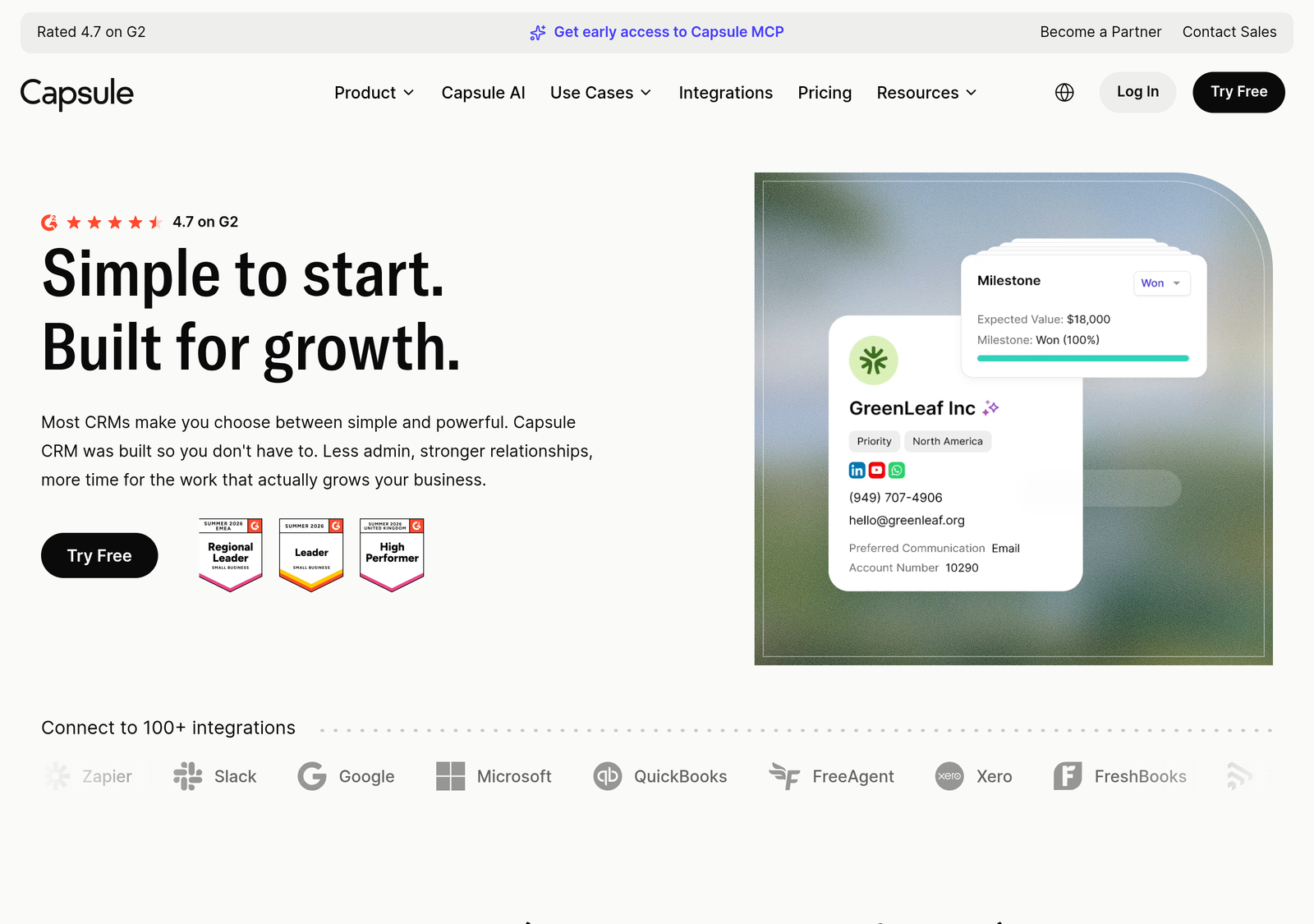
A contact-and-pipeline CRM: track people and organisations, log interactions, move opportunities through a defined sales pipeline, and see where each deal actually stands. It’s deliberately simpler than an enterprise CRM, with fewer configuration options. But it offers a much shorter path from signup to actually using it, and that matters more than feature depth for a lot of small teams.
Key Features
- Contact and organisation management — free tier, up to 250 contacts.
- Sales pipeline tracking — one pipeline on Free, multiple pipelines on paid tiers for teams running distinct sales processes.
- Custom fields — 5 on the free tier, expanding on paid plans for more tailored data capture.
- Project management (Growth tier and up) — turning a closed deal into a tracked project without switching to a separate tool.
- Workflow automations (Growth tier and up) — automatic task creation or status changes triggered by pipeline events.
Product Overview
The problem Capsule solves is the same one every CRM addresses: keeping track of who you’ve talked to, what was discussed, and what happens next, in a way that survives someone forgetting or leaving the company. That’s rather than living in one person’s inbox or memory. Capsule’s specific answer is deliberately lightweight: a contact record, a pipeline stage, and a task list. There’s no deep configuration layer to work through first, unlike larger CRMs. That trade-off is less customisation for a much shorter time-to-value. It’s the entire reason Capsule exists as a distinct product in a crowded category.
Real-World Use Cases
- A 2-person consulting practice runs entirely on the free tier. 250 contacts covers most solo or duo consultancies’ active relationship count comfortably, at zero cost.
- A small agency tracking new business uses the sales pipeline to see exactly how many prospects are at each stage. That replaces a spreadsheet that previously required manual updates and had no shared visibility across the team.
- A growing team past the 250-contact or 2-user limit moves to Starter for a specific reason: staying on Free and hitting the wall mid-quarter is worse than budgeting for the upgrade in advance.
- An agency that closes a deal and needs to deliver it uses Growth tier’s project management to carry the same contact record from “prospect” to “active client project.” No re-entering data into a separate delivery tool is needed.
Pricing
| Plan | Price (annual) | Limits |
|---|---|---|
| Free | $0 | 250 contacts, 2 users, 1 pipeline, 5 custom fields |
| Starter | $18/user/mo | 30,000 contacts |
| Growth | $36/user/mo | 60,000 contacts, adds automations and project management |
| Ultimate | Custom quote | Designed for 5+ user teams, dedicated account manager, custom training |
Update, verified directly September 2026: Starter ($18/user/month) and Growth ($36/user/month) are now confirmed directly against Capsule’s own live pricing page, checked with a JavaScript-capable browser rather than a static fetch — our original tooling couldn’t execute the page’s interactive pricing calculator, which is why these were first reported as third-party sourced. That gap is now closed. Capsule has also restructured its lineup since this review was first written: the previous fixed-price top tier is gone, replaced by “Ultimate,” which is now custom-quoted rather than a published per-user rate.
Estimate your annual cost
Starter and Growth rates confirmed directly against Capsule’s live pricing page, September 2026. Ultimate isn’t included since it’s custom-quoted, not a fixed rate. Free is capped at 2 users regardless of the slider.
Feature/Value Comparison: Capsule vs. a Larger CRM
| Capsule CRM | Enterprise CRM (e.g. Salesforce) | |
|---|---|---|
| Setup time | Fast, minimal configuration | Often requires dedicated admin time or a consultant |
| Free tier | Genuinely usable, 250 contacts | Rare or heavily limited |
| Customisation depth | Moderate | Extremely deep, at the cost of complexity |
| Best for | Small teams, straightforward pipelines | Large sales orgs with complex processes |
Pros and Cons
| Pros | Cons |
|---|---|
| Free tier is genuinely usable, not a time-limited trial | No phone or live chat support on every plan |
| Fast setup, minimal configuration overhead | Free tier’s 2-user cap is tight for anything beyond a solo or duo operation |
| Project management available without switching tools (Growth+) | Less customisation depth than an enterprise CRM, by design |
Alternatives
- Less Annoying CRM — an even simpler tool built specifically for solopreneurs, with flat-rate pricing that avoids per-feature upgrade tiers entirely.
- Attio — a more tech-forward option with a genuinely generous free tier (3 seats, 50,000 records). Worth considering if your team is comfortable configuring a more flexible, less opinionated tool.
- OnePageCRM — an action-focused CRM built around turning every contact into a defined next step. A good fit if pipeline visibility matters less to you than a clear daily action list.
- Folk — built around relationship management for teams that work primarily through LinkedIn and email outreach rather than a formal sales pipeline. Worth a look if your process is more networking-driven than stage-based selling.
Choosing between these by actual workflow, not features
These alternatives don’t compete primarily on feature count. They compete on which mental model of “managing relationships” matches how you actually work. Capsule and OnePageCRM both assume a defined pipeline with stages. Folk assumes a looser, relationship-first network where a rigid pipeline doesn’t reflect reality. Attio sits somewhere in between: flexible enough to configure either way, but requiring more setup effort to get there. Picking based on feature comparison alone, without asking which model matches your actual sales process, is a common mistake. It leaves you fighting a tool that’s individually excellent but structurally wrong for your workflow.
Detailed Analysis
What changed: pricing is now confirmed, and the tier structure shifted
This is worth being transparent about rather than quietly editing it away. This review originally reported paid pricing as third-party sourced, because our first-pass fetch tooling couldn’t execute the JavaScript calculator Capsule’s pricing page uses to display final numbers. Checked again directly with a browser capable of running that calculator, Starter is confirmed at $18/user/month and Growth at $36/user/month. Separately, Capsule has restructured its lineup since this review was first written — there is no longer a fixed-price “Advanced” tier, and the top tier (“Ultimate”) is now custom-quoted rather than a published rate. Both changes are reflected in the pricing table above.
The free-tier cliff is worth planning for
250 contacts and 2 users sounds generous until you consider how CRM contact counts actually grow. Every prospect, past client, and vendor contact typically gets logged, not just active deals. A genuinely small operation can hit 250 contacts faster than expected once historical relationships are included. Know roughly where your contact count sits before committing to Free as a long-term plan. That way, the eventual upgrade to Starter is a planned budget line rather than a surprise mid-project.
Frequently Asked Questions
Is the free tier actually usable, or a crippled trial?
Genuinely usable and not time-limited: 250 contacts, 2 users, 1 pipeline, verified directly against Capsule’s own pricing page. It’s a real product tier, not a trial with an expiry date.
Is Capsule’s paid pricing actually confirmed now?
Yes, for Starter ($18/user/month) and Growth ($36/user/month) — both verified directly against Capsule’s own live pricing page in September 2026. Ultimate is custom-quoted, so there’s no fixed number to confirm; contact Capsule directly for that tier’s pricing.
Can I import contacts from a spreadsheet?
CRM platforms in this category generally support CSV import as a standard onboarding feature. Confirm Capsule’s current import process and any contact-count implications directly before a bulk import. A large import could push you past the free tier’s 250-contact limit immediately.
Does Capsule integrate with email platforms?
Check current integration listings directly. Email integration depth, for Gmail or Outlook, is a common differentiator in this category. Confirm it specifically supports your existing email setup before committing.
What happens to my data if I downgrade from a paid tier back to Free?
We could not independently verify Capsule’s specific behaviour if a contact count already exceeds Free’s 250-contact limit at the point of downgrading. Confirm directly with support before assuming existing data is either fully preserved or partially restricted. This varies by vendor and matters if you’re ever considering scaling back.
Is Capsule a good fit for a service business, not just sales?
Yes, reasonably. The underlying contact-and-pipeline model works for tracking client relationships and project status generally, not strictly transactional sales. A consultancy or agency using “pipeline stages” to represent project phases rather than deal stages is a legitimate, common use of the same structure.
How We Scored This
| Criterion | Score | Why |
|---|---|---|
| Free tier value | 8/10 | Genuinely usable at 250 contacts and 2 users, not a time-limited trial |
| Pricing transparency | 8/10 | Starter and Growth confirmed directly against Capsule’s own live pricing page; Ultimate honestly disclosed as custom-quoted |
| Ease of setup | 8/10 | Deliberately simpler than an enterprise CRM, fast to start using |
| Growth path | 7/10 | Three confirmed tiers plus a custom top tier scale contact count and features reasonably for a small team |
Overall: 7.4/10. Methodology: each criterion scored against the evidence above. Updated September 2026 after directly confirming Starter/Growth pricing and correcting a support claim that couldn’t be sourced.
PROOF Score
Overall: 7.4 / 10 — Recommended. Scored under our PROOF methodology — five checkable pillars, not a vibe.
Final Decision
- Choose Free if: you’re a solo operator or two-person team with fewer than 250 total contacts.
- Choose Starter if: you’ve outgrown Free’s contact or user limit but don’t need automations or project management yet.
- Choose Growth if: workflow automation or built-in project management would replace a separate tool you’re currently paying for.
- Confirm Ultimate’s custom quote directly if you’re past Growth’s limits — Starter and Growth pricing above is already confirmed.
How We Assessed This
Capsule’s free, Starter, and Growth tier pricing is confirmed directly against its own live pricing page as of September 2026. Ultimate is disclosed as custom-quoted because that’s genuinely how Capsule prices it, not because we couldn’t find a number. The customer-support characterization in an earlier version of this review used a quote we could not trace to any source; it has been corrected to reflect what independent review platforms (G2, Trustpilot, Capterra) actually show, which is predominantly positive with a minority of specific complaints. Disclosure: this page contains an affiliate link to Capsule CRM — if you sign up through it, we may earn a commission at no extra cost to you. This does not affect our editorial recommendation or score.
Related
Alternatives worth comparing