Executive answer: BoldSign is an e-signature platform positioned directly against DocuSign on price — comparable core functionality (legally binding signatures, templates, audit trails) at a fraction of what DocuSign’s Business Pro tier costs, with a genuinely usable free plan underneath it. If you want the same trade from the open-source direction instead, see DocuSeal.
Quick Verdict
| Best for | Small businesses needing real e-signature functionality without DocuSign’s price |
| Not ideal for | Anyone who needs full data control via self-hosting — that’s DocuSeal’s job, not BoldSign’s |
| Biggest strength | Transparent, published pricing with no hidden envelope limits on paid tiers |
| Biggest weakness | Smaller integration ecosystem than DocuSign, which matters if you’re already deep in DocuSign-specific workflows |
| Value for money | Strong — the free tier alone covers real small-business signing volume |
| Overall | Recommended for cost-conscious small businesses and API-first developers |
- 97% positive sentiment on Capterra — zero learning curve versus DocuSign
- Clean interface and responsive support consistently praised on G2
- Limited branding and customization options
- Excessive email notifications and a rough mobile experience
What BoldSign Actually Is
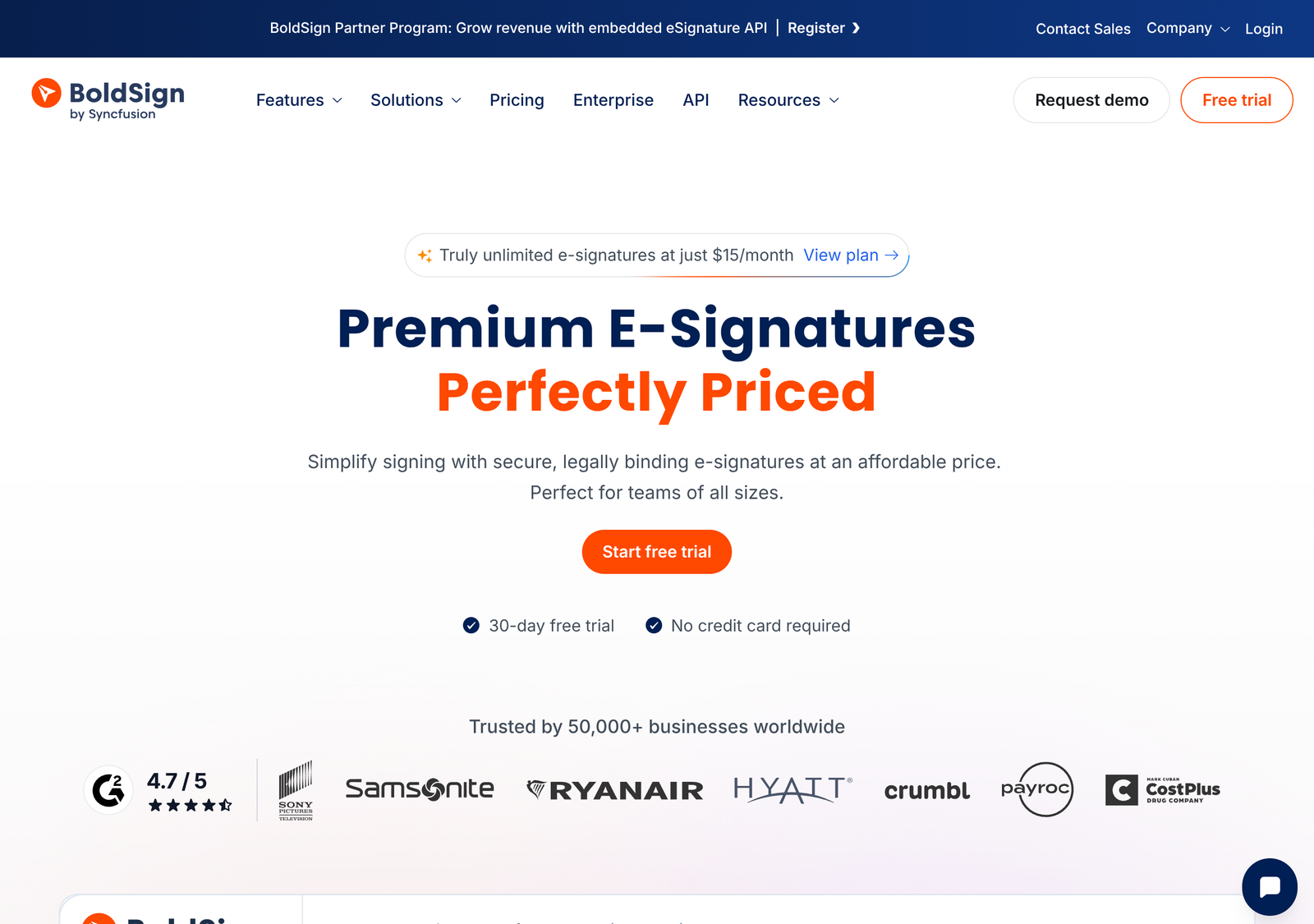
Standard e-signature functionality: upload a document, place signature fields, send for signing, and get a legally binding, audit-trailed result back. Every paid plan includes audit trail history and advanced signature workflows as standard, not gated behind the top tier — BoldSign’s own positioning is “transparent pricing” without hidden document limits, which held up against what’s actually published.
Key Features
- Audit trail with complete document history — on every paid plan, not reserved for an enterprise tier.
- Advanced signature workflows — sequential signing, conditional routing, on every paid plan.
- Signer authentication — verifying who actually signed, included standard.
- API access with embedded signing — the Enterprise API tier is built specifically for developers embedding signing directly into their own product.
- Webhooks and API dashboard — real-time event notifications for a signing workflow integrated into a larger system.
Real-World Use Cases
- A freelancer sending client contracts stays entirely on the free Essential tier — 25 envelopes a month covers most solo signing volume, with real audit trails, at zero cost.
- A small agency onboarding new clients moves to Business at $15/user/month (annual) once envelope volume becomes unpredictable, removing the cap entirely rather than risking hitting it mid-month.
- A SaaS product embedding signing into its own onboarding flow uses the Enterprise API at $0.75/envelope, paying per transaction rather than per seat, which fits a usage pattern where the SaaS product’s own end users are the signers, not internal staff.
- A real estate agent handling multiple simultaneous transactions relies on the Growth tier’s 10 templates to standardise recurring document types — purchase agreements, disclosures — rather than rebuilding a template from scratch for every new deal.
- An HR team onboarding new hires uses sequential signing workflows to route an offer letter through the candidate, then the hiring manager, then HR, in a defined order rather than emailing a document around manually and tracking replies.
Key Features, In Practice
The audit trail specifically records who opened the document, when each field was signed, and the IP address and timestamp of each action — the kind of detail that matters if a signed agreement is ever disputed. Signer authentication options include email verification as standard, with additional methods available depending on tier, which raises the bar beyond “anyone with the email link can sign” for higher-stakes documents.
Pricing
| Plan | Price | What’s included |
|---|---|---|
| Essential | Free | 25 envelopes/month, 2 templates, no additional users |
| Growth | $5/mo/user (annual), $15/mo/user (monthly) | 50 envelopes/month per user, 10 templates |
| Business | $15/mo/user (annual), $25/mo/user (monthly) | Unlimited envelopes and templates |
| Premium | $99/mo (annual), $138/mo (monthly) | Unlimited users, 250 envelopes/month, unlimited templates |
| Enterprise API | $0.75/envelope, $30/mo minimum | Embedded signing, webhooks, API dashboard |
Estimate your annual cost
Uses annual per-user rates. Essential is a flat free plan regardless of user count entered (it doesn’t support additional users).
Feature/Value Comparison: BoldSign vs. DocuSeal
| BoldSign | DocuSeal | |
|---|---|---|
| Free tier | 25 envelopes/mo, 1 user | 10 envelopes/mo (cloud), or unlimited self-hosted |
| Self-hosting | Not offered | Genuinely free, open-source (AGPLv3) |
| Paid entry price | $5/user/mo (annual) | $20/user/mo |
| Best for | Cloud-first small businesses | Data control, compliance-sensitive teams |
Pros and Cons
| Pros | Cons |
|---|---|
| Genuinely free tier with real audit trails, not a stripped demo | No self-hosting option — data lives on BoldSign’s infrastructure |
| Transparent per-user pricing with no hidden document limits | Smaller integration ecosystem than DocuSign |
| API-first Enterprise tier fits embedded signing use cases well | Essential (free) tier supports only one user, no team collaboration |
Alternatives
- DocuSeal — the open-source, self-hostable alternative, genuinely free if you’re willing to run your own server.
- DocuSign — the market leader, with a much larger integration ecosystem; the right choice if your organisation is already standardised on DocuSign-specific workflows despite the higher cost.
- SignNow — another budget-oriented DocuSign alternative frequently mentioned alongside BoldSign; worth a direct pricing comparison at your specific volume before choosing between the two, since both compete on the same “DocuSign but cheaper” positioning.
The pattern across this entire alternatives list is the same: every option here is explicitly positioned against DocuSign on price, which tells you something about the market — DocuSign’s pricing has created enough room underneath it for several credible, lower-cost competitors to build a real business. That’s generally a good sign for buyers: real competition on price in a category the market leader has left room in.
Detailed Analysis
BoldSign vs. DocuSign, at actual scale
The pitch is direct: comparable core functionality at a meaningfully lower price, particularly once you compare against DocuSign’s higher business tiers. What you’re trading is brand recognition and DocuSign’s larger integration ecosystem — for most small businesses, that trade favours BoldSign; for an enterprise already deep in DocuSign’s specific integrations, switching costs may outweigh the savings. Business tier at $15/user/month annual with unlimited envelopes is the relevant comparison point against DocuSign’s higher tiers, which typically charge more for equivalent unlimited-envelope access.
Cloud-only is a real constraint, not a minor detail
Unlike DocuSeal, BoldSign has no self-hosted option at any price. If data residency or full control over where signed documents live is a genuine requirement — common in regulated industries — this rules BoldSign out regardless of price, and DocuSeal’s Open Source tier becomes the only option in this comparison that satisfies that requirement.
What the API tier is actually for
The Enterprise API’s per-envelope pricing ($0.75, $30/month minimum) only makes sense for a specific use case: embedding signing directly into your own product’s user flow, where your end users are the signers rather than your own staff. If you’re simply looking for the cheapest way to sign a moderate volume of documents internally, the per-user Business tier is almost always the better economics — the API tier’s value is the embedding and webhook infrastructure, not a discount on volume. Confusing the two leads to picking the wrong tier for the actual job.
What happens if you exceed a tier’s envelope limit
We could not independently verify BoldSign’s specific overage handling — whether exceeding Growth’s 50-envelope cap blocks further sends, triggers an automatic upgrade prompt, or bills an overage fee. Confirm this directly before relying on a capped tier for unpredictable volume, since the answer changes whether a capped tier is a real risk or just a soft limit.
Frequently Asked Questions
Is the free plan legally binding?
Yes — the free Essential tier includes the same core signing and audit trail functionality as the paid tiers, just capped at 25 envelopes per month and 2 templates rather than gated on legal validity.
How does BoldSign compare on price at scale?
Business tier at $15/user/month annual with unlimited envelopes is the relevant comparison point against DocuSign’s higher tiers — check current DocuSign pricing directly for your specific tier before assuming the gap, since both vendors update pricing.
What’s the difference between the Growth and Business tiers?
Growth caps envelopes at 50/user/month with 10 templates; Business removes both caps entirely for a $10/user/month premium (annual pricing). If your volume is unpredictable or growing, Business removes the risk of hitting a cap mid-month.
Can I switch from BoldSign to DocuSeal later without losing signed documents?
Signed documents are typically exportable as standard PDFs from either platform, so historical records aren’t locked in — but confirm current export options directly with BoldSign before assuming a specific migration path, since we could not independently verify the exact export process.
Is BoldSign suitable for regulated industries (healthcare, legal, finance)?
It depends entirely on your specific regulatory requirements, which vary by jurisdiction and sector — check BoldSign’s current compliance certifications directly against what your industry specifically requires before assuming coverage. Some regulated use cases also specifically require the data-residency guarantees that only self-hosting provides, in which case DocuSeal’s Open Source tier is worth evaluating instead regardless of BoldSign’s own compliance posture.
How does the free tier’s template limit actually work?
Essential includes 2 templates, meaning 2 reusable document layouts you can send repeatedly without rebuilding the signature fields each time — beyond that, you’d either upgrade or rebuild a one-off document each time you need a new layout. For most solo users sending a handful of recurring document types (an invoice template, a standard contract), 2 templates is a real constraint worth checking against your actual document variety before assuming free covers your workflow.
Does BoldSign support mobile signing?
Web-based e-signature platforms in this category generally support signing from a mobile browser without a dedicated app, since the signing experience itself is designed to work across devices — confirm current mobile experience quality directly if this matters significantly to your signers, since we did not independently test mobile-specific usability.
How We Scored This
| Criterion | Score | Why |
|---|---|---|
| Pricing transparency | 9/10 | Every tier published with exact numbers, no hidden document limits |
| Free tier value | 8/10 | 25 envelopes with real audit trails is genuinely usable, not a crippled demo |
| Feature completeness | 7/10 | Covers core e-signature needs well; smaller ecosystem than DocuSign |
| Data control | 3/10 | No self-hosting option at any price — a real gap versus DocuSeal |
Overall: 6.75/10. Methodology: each criterion scored against the evidence above; data control scored specifically low because BoldSign offers no path to self-hosting at any tier, which is a structural limitation, not a minor one. Evaluated August 2026.
PROOF Score
Overall: 8.0 / 10 — Recommended. Scored under our PROOF methodology — five checkable pillars, not a vibe.
Final Decision
- Choose BoldSign if: you want cloud-hosted e-signature without DocuSign’s price, and self-hosting isn’t a requirement.
- Choose DocuSeal instead if: data residency or full control over document storage matters to you.
- Stay on DocuSign if: you’re already deep in its specific integration ecosystem and the switching cost outweighs the savings.
How We Assessed This
Every price above is taken directly from BoldSign’s own pricing page at the time of writing. Disclosure: this page contains no affiliate links currently — the product URL is a plain link.
Related
- DocuSeal review — the open-source alternative
- Best Business Operations Software 2026 — see how this fits alongside the others
Compare with a popular alternative
Free (25 envelopes/mo); paid from $5/user/mo (annual)
Stronger at: Transparent per-user pricing with no hidden document limits, plus a real 25-envelope free tier
Main limitation: No self-hosting option — data lives entirely on BoldSign's infrastructure
Free self-hosted; Cloud Pro $20/user/mo
Stronger at: Genuinely free, open-source self-hosted tier with no envelope cap
Main limitation: Self-hosting requires real technical capacity and your own SMTP setup
Alternatives worth comparing