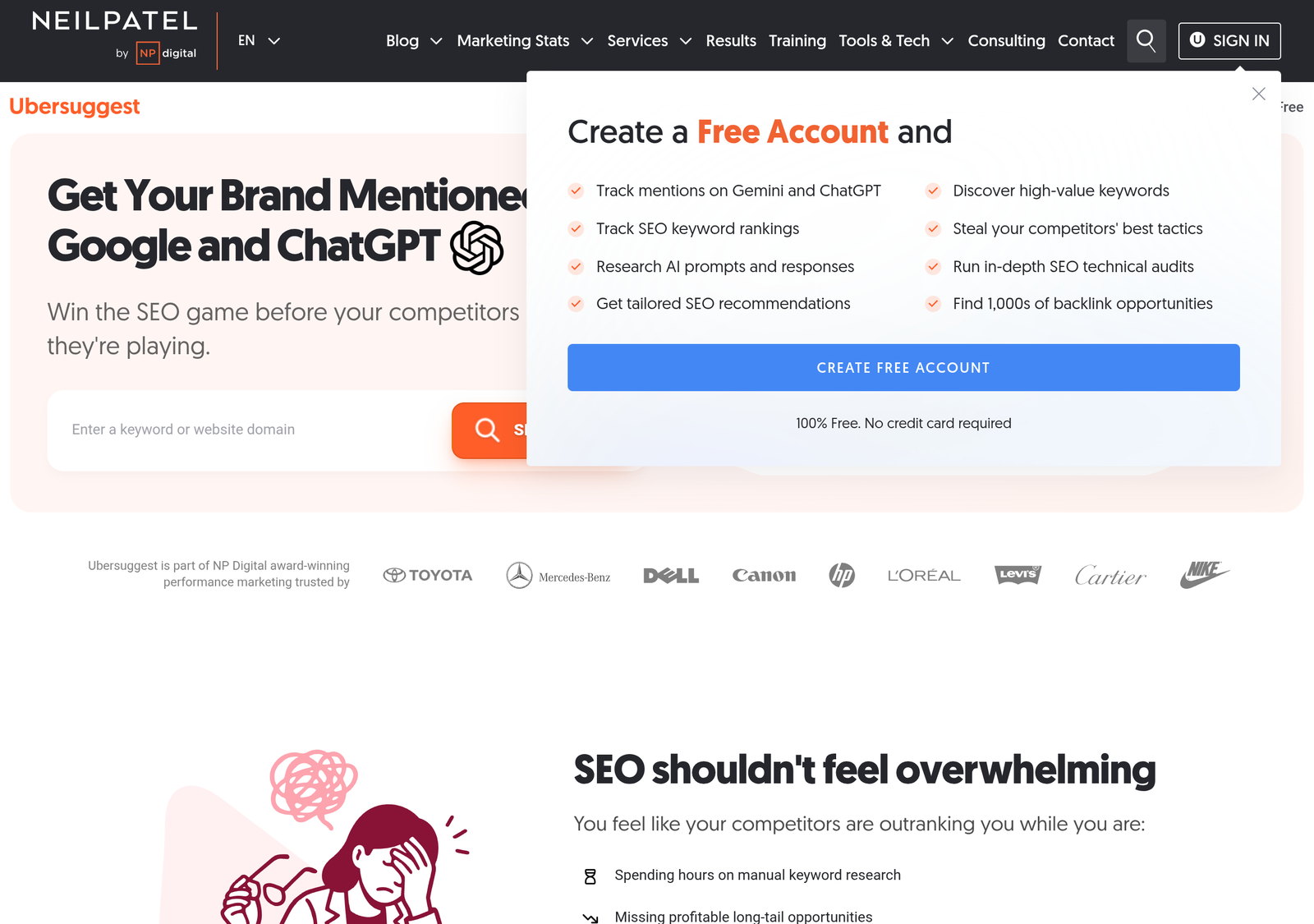
Ubersuggest is Neil Patel’s entry in the broader SEO tools market, positioned as the affordable alternative to Ahrefs and SEMrush. It covers keyword research, competitor analysis, site audits, rank tracking and backlink data in one interface — and it does something almost unheard of in SEO software: it sells a lifetime licence.
That lifetime option is the most interesting thing about it, and the part most reviews handle badly. This review does the arithmetic.
Executive Answer
Ubersuggest is not as good as Ahrefs or SEMrush, and it doesn’t need to be. It’s priced for a solo blogger or small business owner, and against the real alternative — working with no data at all — it’s clearly worth having.
The lifetime plan pays for itself in about ten months versus monthly billing. If you’re confident you’ll still be doing SEO in a year, it’s the obvious purchase. If you’re not, don’t buy it.
Quick Verdict
| Category | Verdict |
|---|---|
| Best for | Bloggers, solo site owners, small businesses doing their own SEO, people learning the field |
| Not ideal for | Agencies, competitive niches, anyone who needs defensible data in client reports |
| Biggest strength | Price — including a genuine lifetime option |
| Biggest weakness | Smaller data index than the premium suites, especially on backlinks and long-tail keywords |
| Monthly pricing | Individual $29, Business $49, Enterprise $99 |
| Lifetime pricing | Individual $290, Business $490, Enterprise $990 — one-time |
| Overall | Recommended for solo operators; buy lifetime if you’re staying |

- Excellent value, especially with the lifetime-deal option
- Explains its own metrics — genuinely beginner-friendly
- Data depth is weak against premium suites like Ahrefs
- Less suited to professional, client-facing work
The Honest Positioning
Let’s be direct, because a lot of Ubersuggest reviews aren’t. Ahrefs and SEMrush have better data. Their crawl indexes are larger, their backlink coverage is deeper, and their long-tail keyword discovery finds things Ubersuggest misses. Anyone telling you otherwise is selling something.
But the comparison most readers need isn’t “is this as good as Ahrefs?” It’s “is this better than guessing?” Premium suites are priced for agencies and in-house teams with budgets to match. Ubersuggest is priced for one person with a website. Judged against its actual alternative — no keyword data, no rank tracking, no site audit — it’s obviously worth the money.
The failure mode is buying it expecting Ahrefs at a discount, then feeling cheated. Buy it expecting a competent budget tool and it delivers exactly that.
What You Get, and What the Tiers Actually Change
| Plan | Monthly | Lifetime | Projects | Tracked keywords |
|---|---|---|---|---|
| Individual | $29/month | $290 one-time | 1 | Entry-level allowance |
| Business | $49/month | $490 one-time | 7 | 400 |
| Enterprise / Agency | $99/month | $990 one-time | 25 | 2,000 |
Note what changes between tiers: capacity, not capability. All three give you keyword research, site audit, rank tracking and backlink analysis. What you’re buying at higher tiers is more projects and more tracked keywords, not features that were withheld.
That’s a genuinely fair pricing structure and worth crediting. Plenty of SEO tools paywall the useful features and leave the cheap tier deliberately crippled. Ubersuggest doesn’t. If you run one site, Individual gives you the whole toolset.
A 7-day free trial is available on the monthly plans.
Lifetime or Monthly? Run the Numbers
Lifetime vs monthly calculator
Published prices, August 2026. The only real variable is how long you’ll keep using it.
Method: monthly total = monthly price × months used. Break-even = lifetime price ÷ monthly price, rounded up. Assumes prices hold and the lifetime licence continues to be honoured — the central risk with any lifetime software deal, and one no calculator can price. Excludes taxes and promotional discounts.
The Risk the Calculator Can't Price
Break-even at ten months looks compelling, and the arithmetic is sound. But weigh a lifetime software deal the way you'd weigh any of them: it's good value if the tool stays useful and maintained for years, and worth nothing if you stop opening it in three months or if the terms change.
The practical advice: use the free trial and then a month or two of monthly billing first. If you find yourself opening it weekly, buy lifetime. If you don't, you've saved yourself $290. Nobody regrets that sequence; plenty of people regret the reverse.
Where the Data Is Weaker
The gap against premium tools shows up in two specific places, and it's worth knowing exactly where rather than treating "worse data" as a vague warning.
Backlinks
Maintaining a large web crawl index is the genuinely expensive part of running an SEO tool, and it's where Ahrefs and SEMrush spend their money. Ubersuggest's index is smaller, so it will miss links the bigger tools find. For assessing your own backlink profile at a high level it's adequate; for competitive link-gap analysis it isn't.
Long-Tail Keywords
Common head terms are covered fine. The further into the long tail you go, the more Ubersuggest thins out. Since long-tail terms are exactly where a small site can realistically rank, this is the more consequential of the two gaps for its own target audience.
And a Caveat That Applies to Every Tool
Search volume figures should be treated as directional in any SEO tool, Ubersuggest included. They're modelled estimates, not measurements. Use them to compare terms against each other, never as literal traffic forecasts. A tool showing "1,900 searches/month" is telling you a term is bigger than one showing 200 — not that you'll get 1,900 visits.
What It Does Well
- Keyword research that's fast enough to actually use during writing, rather than as a separate research ritual
- Site audit that surfaces the common technical problems in plain language
- Rank tracking included at every tier rather than sold separately
- Content ideas based on what's performing in your topic
- An interface that explains its own metrics, which premium tools largely don't — genuinely valuable if you're learning
That last point deserves more credit than it gets. Ahrefs assumes you know what you're looking at. Ubersuggest assumes you might not, and it's built accordingly. For someone learning SEO, that's a feature, not a compromise.
How to Actually Use It Week to Week
Tools like this get bought and then abandoned, usually because nobody sets out what to do with them. A workable routine for a solo site owner looks like this.
Before writing anything, check the term you plan to target and two or three variations of it. You're not looking for the biggest number — you're looking for the version of the phrase real people use, and for related questions worth covering in the same piece. Five minutes here changes what you write.
Once a month, look at rank tracking. Not to celebrate movement, but to spot pages that slipped. A page falling from position 6 to 14 is usually fixable and always worth more attention than a new article.
Once a quarter, run the site audit. Most of what it finds will be minor. The value is catching the occasional real problem — a broken redirect chain, a noindex tag somebody left on — before it costs you months.
Ignore the backlink section unless link building is an active project. Given the index limitations, treating it as a rough indicator rather than a complete picture will save you from wrong conclusions.
That's perhaps an hour a month. If you can't commit to that, the lifetime deal isn't a bargain — it's a subscription you cancelled in advance.
Ubersuggest vs. the Alternatives
| Ubersuggest | Ahrefs / SEMrush | Free tools (GSC, Keyword Planner) | |
|---|---|---|---|
| Price | $29–99/mo, or lifetime | High monthly subscription | Free |
| Lifetime option | Yes | No | n/a |
| Backlink index | Smaller | Very large | Minimal |
| Long-tail depth | Adequate | Deep | Limited |
| Rank tracking | Included | Included | Not really |
| Beginner friendliness | High | Low | Medium |
| Best for | Solo operators | Agencies and in-house teams | Anyone, as a baseline |
Why the differences matter:
- Against Ahrefs/SEMrush: you're trading data depth for roughly an order of magnitude in price. In a low-competition niche that trade is fine — the keyword you need to find isn't hidden. In a competitive one, the winning term is often precisely the one your rival's better tool surfaced and yours didn't.
- Against free tools: Search Console tells you how you're already performing but won't help you find opportunities you don't yet rank for. That discovery gap is what you're paying Ubersuggest to close. Use both — Search Console is the ground truth Ubersuggest can't give you.
- Against other budget tools: the lifetime option is the differentiator. Nothing else at this level offers it.
Our Rating, and How We Reached It
Based on Ubersuggest's published pricing and plan limits, comparison against competitor feature sets and pricing, and aggregated user reports, as of August 2026. No first-hand data-accuracy testing was performed for this review, and no comparison of index sizes was independently measured.
| Criterion | Weight | Assessment |
|---|---|---|
| Value for money | 30% | Excellent — especially with the lifetime option |
| Data quality and depth | 25% | Weak against premium suites; adequate for small sites |
| Feature completeness | 20% | Strong — no features paywalled behind higher tiers |
| Beginner friendliness | 15% | Excellent — explains its own metrics |
| Suitability for professional use | 10% | Weak — data depth limits client-facing work |
Limitations of this scoring: value is weighted heavily because price is the entire reason this tool exists. An agency should invert these weights — data quality first — and would conclude Ahrefs is worth several times the price. Both conclusions are correct for their respective readers.
PROOF Score
Overall: 7.2 / 10 — Recommended. Scored under our PROOF methodology — five checkable pillars, not a vibe.
Frequently Asked Questions
Is the free version usable?
There's a limited daily search allowance — enough to evaluate the tool, not enough to work in daily. There's also a 7-day trial on the monthly plans.
Is the lifetime deal worth it?
It breaks even at roughly ten months against monthly billing. Worth it if you're confident you'll still be doing SEO in a year; not if you're unsure.
Can Ubersuggest replace Ahrefs?
For a solo blogger in a low-competition niche, plausibly. For competitive SEO or client work, no — the data gap is the product difference.
What's the difference between the tiers?
Capacity, not features. Individual covers 1 project; Business 7 projects and 400 tracked keywords; Enterprise 25 projects and 2,000 keywords.
Are the search volumes accurate?
They're estimates, as in every SEO tool. Use them comparatively, not as traffic predictions.
Do I still need Google Search Console?
Yes. It's free and it's the only source of truth about your actual performance in Google. Ubersuggest complements it; it doesn't replace it.
Should You Buy Ubersuggest?
Choose it if:
- You run one or a few sites and premium tools are out of budget
- You're learning SEO and want a tool that explains itself
- You're in a low-to-moderate competition niche
- You want to stop paying monthly subscriptions indefinitely
Avoid it if:
- You do client work where data defensibility matters
- You compete in a hard niche where finding the overlooked term is the whole game
- Backlink analysis is central to your strategy
Best alternative if:
- You need serious data: Ahrefs or SEMrush
- You need free: Google Search Console, plus autocomplete-based question tools like AnswerThePublic for ideation — see how it stacks up against Ubersuggest
- You need technical auditing specifically: Screaming Frog, free up to 500 URLs — see how the two compare
Best plan for most users:
Individual — one project, the full toolset, lowest price. Most solo site owners never exhaust it, and the higher tiers only add capacity you're unlikely to use.
Best option for advanced users:
Business lifetime at $490 if you manage several sites. Beyond that, if you genuinely need 25 projects and 2,000 tracked keywords, you're doing professional work and the data-quality gap probably matters more than the saving.
Bottom line:
Ubersuggest is an honest budget tool that doesn't pretend to be a premium one, and the lifetime licence is a genuinely unusual offer in a category built on recurring revenue. Trial it, run it monthly for a month or two, and buy the lifetime licence only once you've proved to yourself that you actually use it. Do it in that order and it's one of the better-value purchases available to a solo site owner.
Pricing and plan limits change, and lifetime offers can be withdrawn. Figures cited are current as of August 2026 — verify before purchasing.
Disclosure: some links on this page may be affiliate links. If you purchase through them we may earn a commission at no extra cost to you. This does not affect our editorial recommendations.
Related
Compare with a popular alternative
$29/month, or $290 one-time
Stronger at: Full toolset at every tier, and a lifetime licence that pays back in ten months
Main limitation: Smaller data index than the premium suites, especially on backlinks
Free to 500 URLs; $279/year
Stronger at: Far deeper technical crawl data, and free for small sites
Main limitation: Technical auditing only u2014 no keyword research or rank tracking
Alternatives worth comparing