“Best payment processing software” hides two unrelated jobs under one label. A SaaS company charging customer credit cards and a freelancer collecting a wire transfer from a client in Germany are not shopping for the same thing, even though every roundup on this topic lists them side by side. This page splits them on purpose: a shortlist for businesses that accept payments, and a shortlist for people who need to get paid across borders. Buying across that line wastes money in both directions.
It also covers the names most people actually search for, Stripe, Square and PayPal, alongside Helcim, Braintree and Shopify Payments, with every rate taken from the vendor’s own pricing page. Two interactive tools below, a quiz and a fee calculator, do the sorting for you.
Rates last checked September 21, 2026. Payment fees change often and vary by country, card type and plan, so confirm the current rate with the provider before you sign up. Anything not confirmed against a vendor page is marked as third-party reported.
Executive Answer
If you are accepting payments:
- Best default for online businesses and SaaS: Stripe. 2.9% + 30¢ per domestic card payment, no monthly or setup fee. The extras to know about: +1.5% on international cards, +1% when currency conversion is needed, and $15 per dispute.
- Best for in-person sales: Square. 2.6% + 15¢ per in-person payment on the free plan, no monthly fee. Online sales on that free plan cost more, 3.3% + 30¢.
- Best when volume grows and you want to see the markup: Helcim. Interchange plus 0.50% + 25¢ online (0.40% + 8¢ in person) at the entry tier, falling as volume rises, with no monthly, PCI or cancellation fee.
- Best if you already have a merchant account and just need a gateway: Authorize.net. Flat $25 a month on every plan, and the Gateway Only tier drops to 10 cents a transaction once you supply your own merchant account.
- Best Merchant of Record for global tax handling: Paddle. One flat rate, 5% plus 50 cents, covers processing, VAT/GST remittance, fraud protection and subscription billing with no separate line items.
- Best if you already sell on Shopify: Shopify Payments. Using a third-party gateway instead adds a 0.6% to 2% fee, depending on your plan.
If you are getting paid:
- Best for freelancers whose clients can pay directly: Wise. Mid-market exchange rate with a stated fee from 0.24%, and free local receiving details in more than 20 currencies.
- Best when a marketplace forces the issue: Payoneer. If Upwork, Fiverr or Amazon only pays out through it, the comparison with Wise is academic; you need the account.
- Best only when a client insists on it: PayPal. 3.49% + 49¢ on invoiced payments and 4% on currency conversion make it the expensive way to be paid.
Find Your Shortlist in Four Questions
Find your shortlist in four questions
It applies the same logic as the rest of the page: what job you need done first, then volume. A starting point, not a verdict; confirm it with the calculator below.
Two Jobs, Not One List
Accepting payments means you are the business collecting money from customers. You need a gateway or processor wired into your checkout, and the decision hinges on your volume, where you sell, whether you already have a merchant account, and whether you want someone else to own tax compliance. Stripe, Square, PayPal, Helcim, Authorize.net, 2Checkout and Paddle all compete for this job, though not all of them are close substitutes. Paddle and 2Checkout’s top tier are Merchants of Record, which is a different product from a processor, and Authorize.net’s cheapest plan is only a gateway.
Getting paid internationally means you are the one being paid: a freelancer, contractor or remote worker whose clients or platforms sit in other countries. The question is how much of your own money disappears in conversion and withdrawal fees before it reaches your bank. Wise and Payoneer compete for this job, and PayPal is the option clients often push on you. None of the merchant tools above will get a freelancer paid by Upwork. We already cover Wise against Payoneer in detail in our dedicated comparison, so this page treats that pairing briefly and links out rather than repeating it.
Sort by Job
| Job | Tool | Core price | Best for |
|---|---|---|---|
| Accepting payments (merchant) | Stripe | 2.9% + 30¢ per domestic card; +1.5% international, +1% currency conversion; $15 per dispute; no monthly fee | Online stores, SaaS, subscriptions |
| Square | Free plan: 2.6% + 15¢ in person, 3.3% + 30¢ online; no monthly fee | Shops, cafes, in-person sellers | |
| PayPal (merchant) | 3.49% + 49¢ per PayPal checkout payment; 2.89% + 29¢ for card payments through its Advanced card processing | Adding a familiar checkout button beside another processor | |
| Helcim | Interchange + 0.50% + 25¢ online, + 0.40% + 8¢ in person at the entry tier; no monthly, PCI or cancellation fee | Growing volume, wanting a visible markup | |
| Braintree | 2.89% + 29¢ per card transaction; $15 per chargeback | Developers already in the PayPal ecosystem | |
| Shopify Payments | 2.5% to 2.9% + 30¢ online, 2.4% to 2.6% + 10¢ in person, by plan | Shopify stores | |
| Authorize.net | $25/mo + 2.9% + 30¢ (All-in-One), or 10¢/transaction with your own merchant account | Existing merchant account holders, established platform integrations | |
| 2Checkout / Verifone | 3.5%–6% + fixed fee, tiered by feature (reported, not vendor-confirmed) | Selling digital goods across many countries with varied local payment methods | |
| Paddle | 5% + 50¢ flat, all-inclusive | SaaS selling globally without an in-house tax team | |
| Getting paid (freelancer/remote worker) | Wise | From 0.24%, mid-market rate, free account | Clients who can pay you directly by bank transfer |
| Payoneer | Layered fees, conversion 1.2%–4%, $29.95/yr if under $6,000 received | Marketplace payouts (Upwork, Fiverr, Amazon) that require it | |
| PayPal (freelancer) | 3.49% + 49¢ on invoiced payments; 4% currency conversion | Clients who will only pay through PayPal |
Sources: Stripe, Square, PayPal, Helcim and Braintree pricing pages, checked September 21, 2026. Shopify’s rates come from its published processing-fees guide (January 2026) and its pricing page for the third-party gateway fee. Other rows are covered in the individual reviews.
Four Pricing Models, and When Each One Wins
Most of the confusion in this category comes from comparing headline rates that are built differently. There are four models, and knowing which one you are looking at matters more than the percentage.
- Flat rate (Stripe, Square, PayPal, Braintree, Shopify Payments, Authorize.net All-in-One): one percentage plus a fixed fee, with the card-network cost folded in. Easy to predict, and easy to underestimate at scale, because you pay the same rate on a cheap debit card as on a premium rewards card.
- Interchange-plus (Helcim, Authorize.net Gateway Only with your own merchant account): the card networks’ cost passes straight through and you pay a stated markup on top. The bill is longer, but the markup is visible and usually falls as volume rises. Helcim’s, for example, steps down across five volume tiers.
- Subscription or membership (Stax): a monthly fee sized to your volume, a small per-transaction fee, and network cost at cost. Third-party reviewers report a $99 monthly fee up to $150,000 a year, $139 up to $250,000 and $199 or more above that, plus 8¢ per in-person and 15¢ per online transaction. Stax’s own pricing page blocked automated checking, so treat these numbers as reported. Reviewers also report multi-year contracts with early termination fees, which is worth confirming before you sign.
- Merchant of Record (Paddle, 2Checkout’s top tier): a higher all-in rate that includes becoming the legal seller and handling sales tax and VAT for you. It is a different product from the three above, and it only makes sense if you actually need the tax work done.
Stripe itself sells both ends of this. The standard rate is flat, but its pricing page also offers a custom package with interchange-plus pricing and volume discounts for large processors, so a growing Stripe customer does not have to leave to get a lower rate.
What Will You Really Pay? Two Examples and a Calculator
Here is the same online business run through every provider’s published rate at two volumes. The numbers come from the same model as the calculator below it, so the two always agree.
| Provider | $10,000 a month | $50,000 a month |
|---|---|---|
| Helcim | $273 (2.73%) | $1,281 (2.56%) |
| PayPal card payments (Advanced) / Braintree | $325 (3.25%) | $1,626 (3.25%) |
| Stripe | $328 (3.28%) | $1,638 (3.28%) |
| Shopify Payments (top of 2.5-2.9% range) | $328 (3.28%) | $1,638 (3.28%) |
| Stax (reported pricing) | $330 (3.30%) | $1,355 (2.71%) |
| Authorize.net All-in-One | $353 (3.52%) | $1,663 (3.33%) |
| Square (Free plan, online) | $368 (3.67%) | $1,838 (3.67%) |
| PayPal Checkout | $410 (4.10%) | $2,051 (4.10%) |
| Paddle (includes sales-tax handling) * | $563 (5.63%) | $2,813 (5.63%) |
Online sales, $80 average order, card-network cost of 2.0% + 10¢ per transaction, USD domestic cards. Monthly fees are included; chargebacks, international and currency-conversion surcharges, hardware and taxes are not. * Paddle’s rate includes sales-tax and VAT handling as Merchant of Record, so it is not a like-for-like comparison. Stax figures are third-party reported.
Three things stand out. First, at these assumptions Helcim’s interchange-plus pricing costs roughly 17% less than Stripe at $10,000 a month and roughly 22% less at $50,000. That is a real saving, but it is not the dramatic multiple you will see quoted elsewhere. Second, the saving depends heavily on your card mix: raise the card-network cost to 2.4%, which is what a rewards-card-heavy customer base looks like, and the gap between Helcim and Stripe shrinks to about 5%. Third, Square’s free plan costs more than Stripe for online sales, because its lower online rate sits on the paid plans. The calculator lets you change all of these:
What will you really pay each month?
Set your volume, average order and card mix. It uses each provider’s published rate (checked September 21, 2026) and adds the monthly fee where there is one.
The results appear here. Without JavaScript, the table above shows the default case.
Card-network cost is interchange plus card-brand assessments, which interchange-plus and membership providers pass through at cost. It varies by card type: debit and basic cards sit low, premium rewards and business cards sit high. 2.0% + 10¢ is an illustrative midpoint, so replace it with the figure from your own statement if you have one. Excludes chargebacks, international and currency-conversion surcharges, hardware, PCI or account fees, and taxes. Paddle’s rate includes sales-tax handling, so it is not like-for-like (striped bar). Stax pricing is third-party reported and modeled at its $199 entry fee above $250,000 a year; reviewers say the fee can be higher, so Stax’s figure at the top of the slider is a minimum.
Accepting Payments: The Tools in Detail
Stripe
Best for online businesses and SaaSThe online default, with surcharges to price in
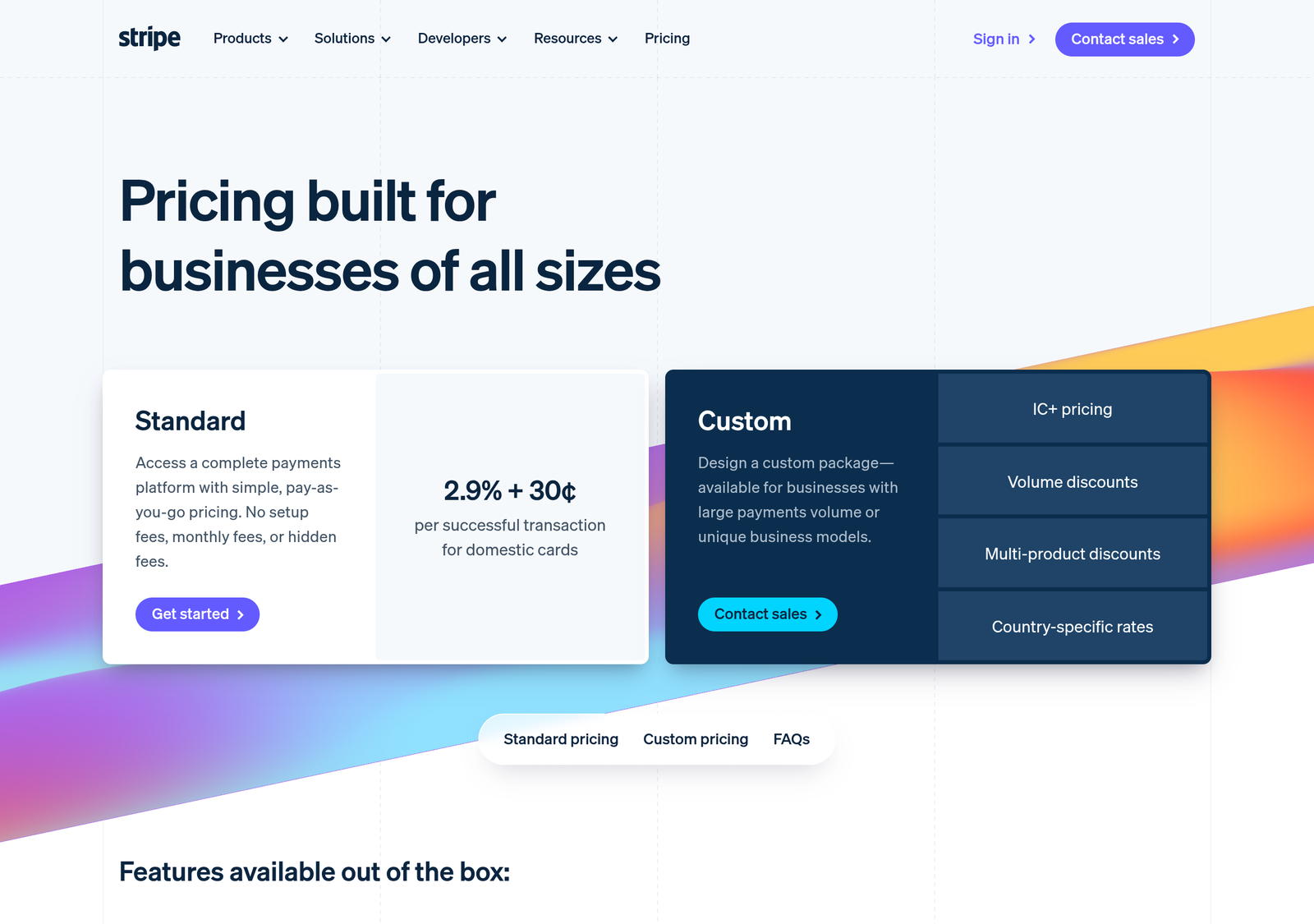
- Standard rate2.9% + 30¢
- Extras+1.5% intl · +1% conversion
- Monthly feeNone
- Dispute fee$15
Official pricing page · We have not published a full review yet; the figures come from the vendor's own pricing page, checked September 21, 2026.
Square
Best for shops, cafes and in-person salesBuilt for in-person selling

- In person (Free)2.6% + 15¢
- Online (Free)3.3% + 30¢
- Monthly feeNone on Free
- Keyed / card on file3.5% + 15¢
Official pricing page · We have not published a full review yet; the figures come from the vendor's own pricing page, checked September 21, 2026.
PayPal
Best beside another processorThe trusted button, not the cheap option
- PayPal checkout3.49% + 49¢
- Cards (Advanced)2.89% + 29¢
- Currency conversion4%
- Chargeback$20 on some card payments
Official pricing page · We have not published a full review yet; the figures come from the vendor's own pricing page, checked September 21, 2026.
Helcim
Best for growing volumeInterchange-plus with the markup on the page
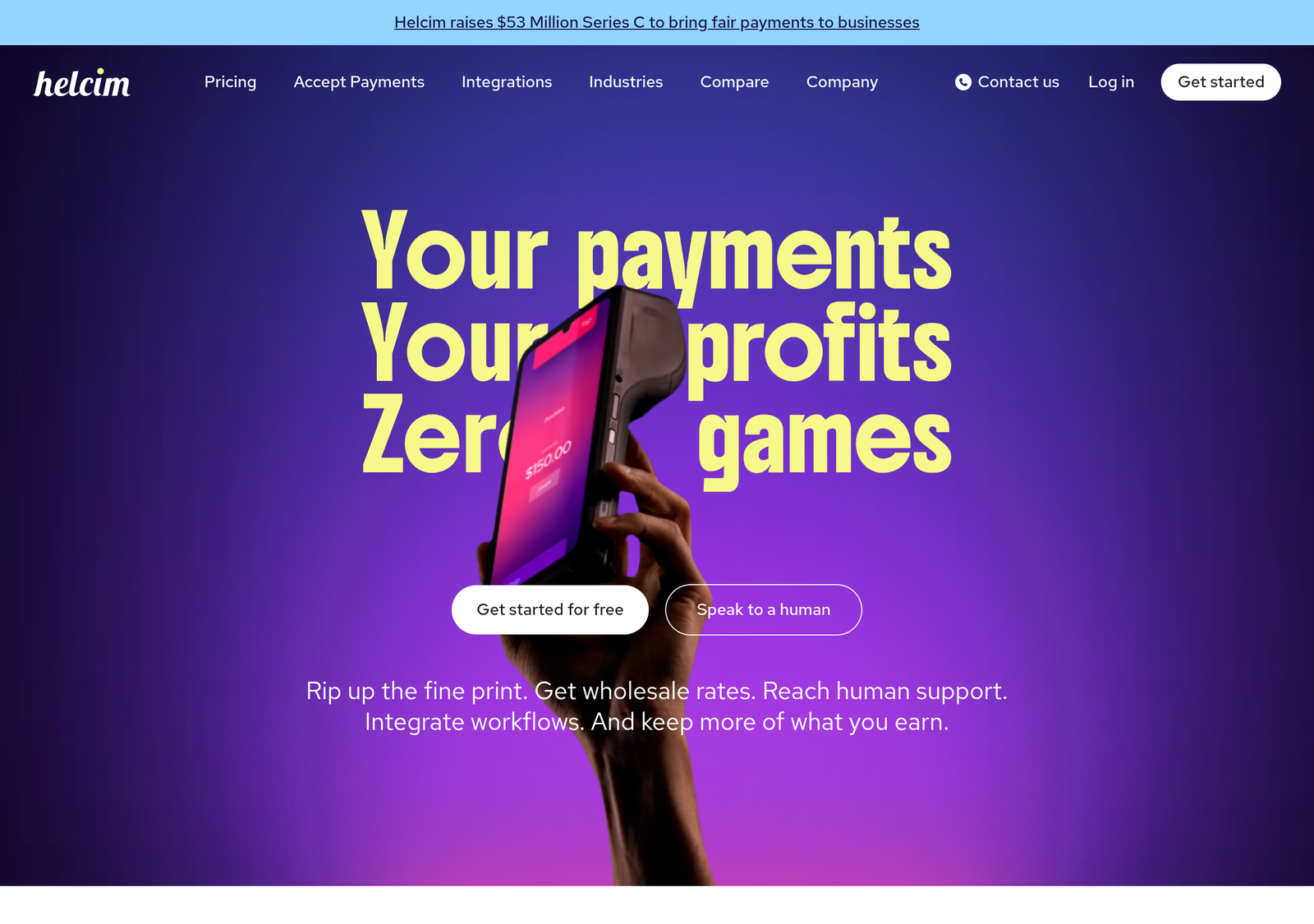
- Online (entry tier)IC + 0.50% + 25¢
- In person (entry tier)IC + 0.40% + 8¢
- Monthly / PCI / cancel$0
- Lost chargeback$15
Official pricing page · We have not published a full review yet; the figures come from the vendor's own pricing page, checked September 21, 2026.
Braintree
Best for developers in the PayPal ecosystemPayPal's developer platform
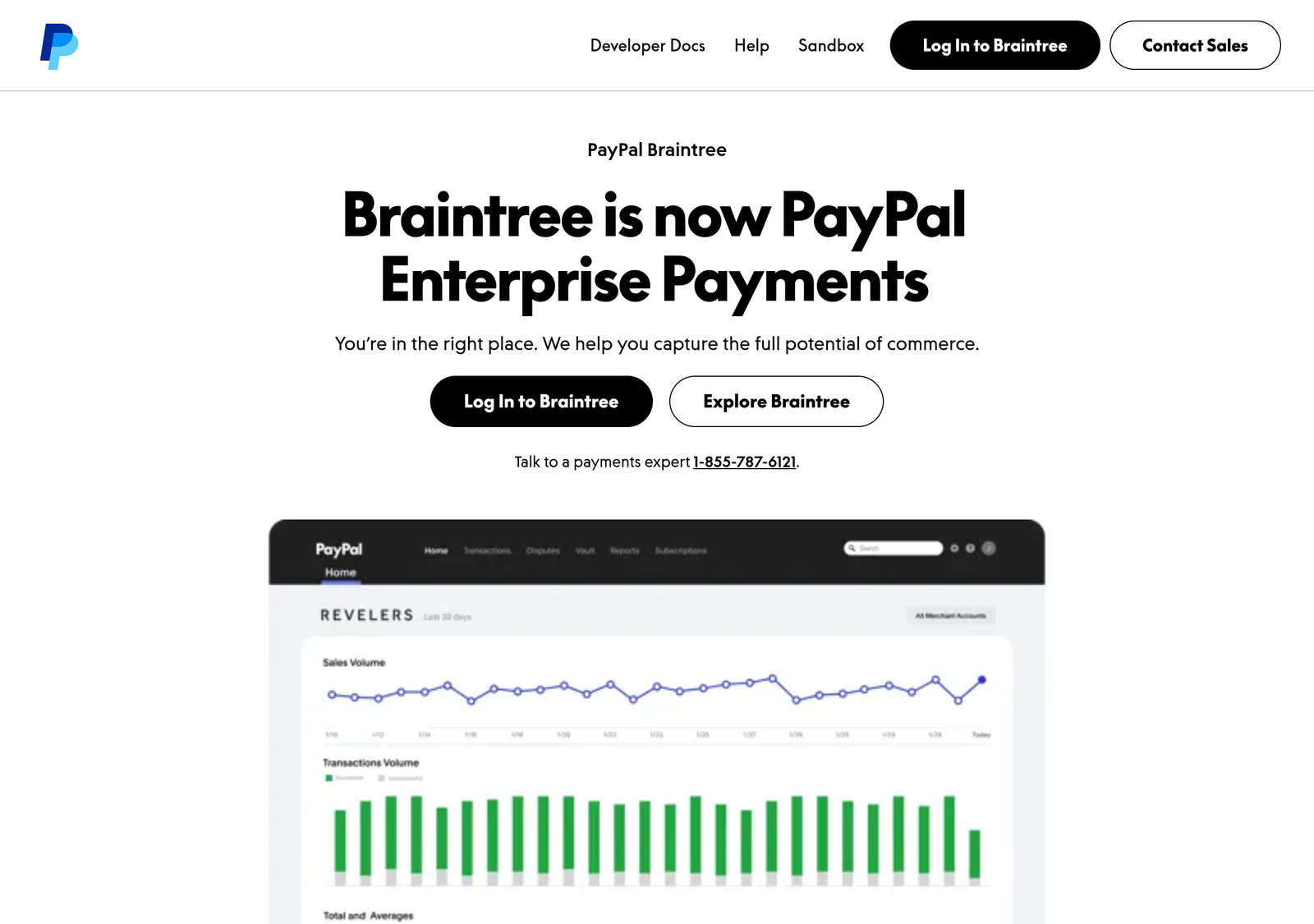
- Cards and wallets2.89% + 29¢
- Chargeback$15
- Monthly feeNone listed
Official pricing page · We have not published a full review yet; the figures come from the vendor's own pricing page, checked September 21, 2026.
Shopify Payments
Best for Shopify storesThe default for Shopify stores

- Online2.5–2.9% + 30¢
- In person2.4–2.6% + 10¢
- Third-party gateway+2% / 1% / 0.6%
- Rates depend onYour Shopify plan
Stax
Third-party reported pricingA membership model for high volume
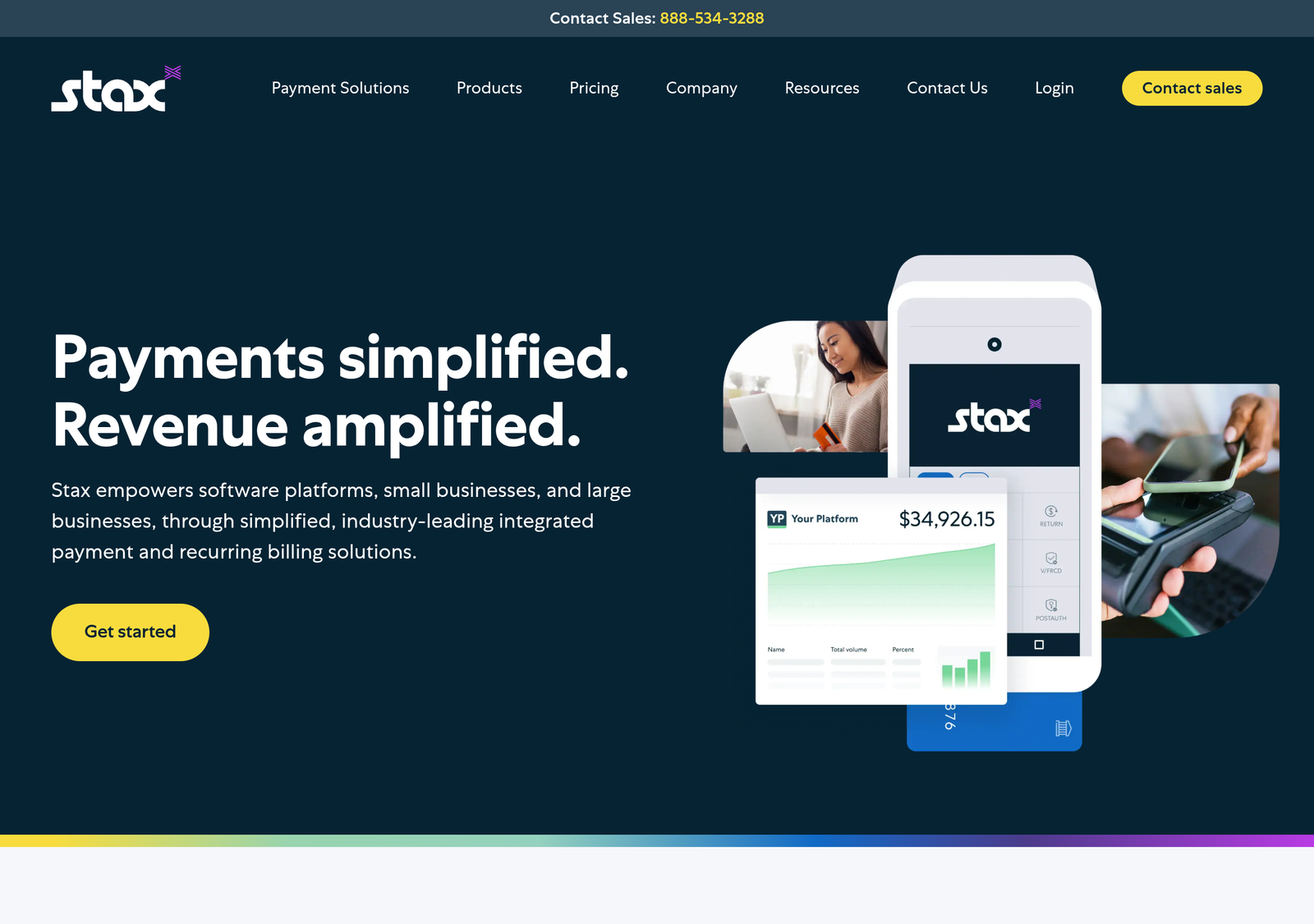
- Monthly fee$99 / $139 / $199+
- Per transaction8¢ in person · 15¢ online
- Network costPassed through
- ContractMulti-year reported
No official pricing check was possible; treat every figure as reported.
Authorize.net
Best with an existing merchant accountA gateway, not automatically a full processor
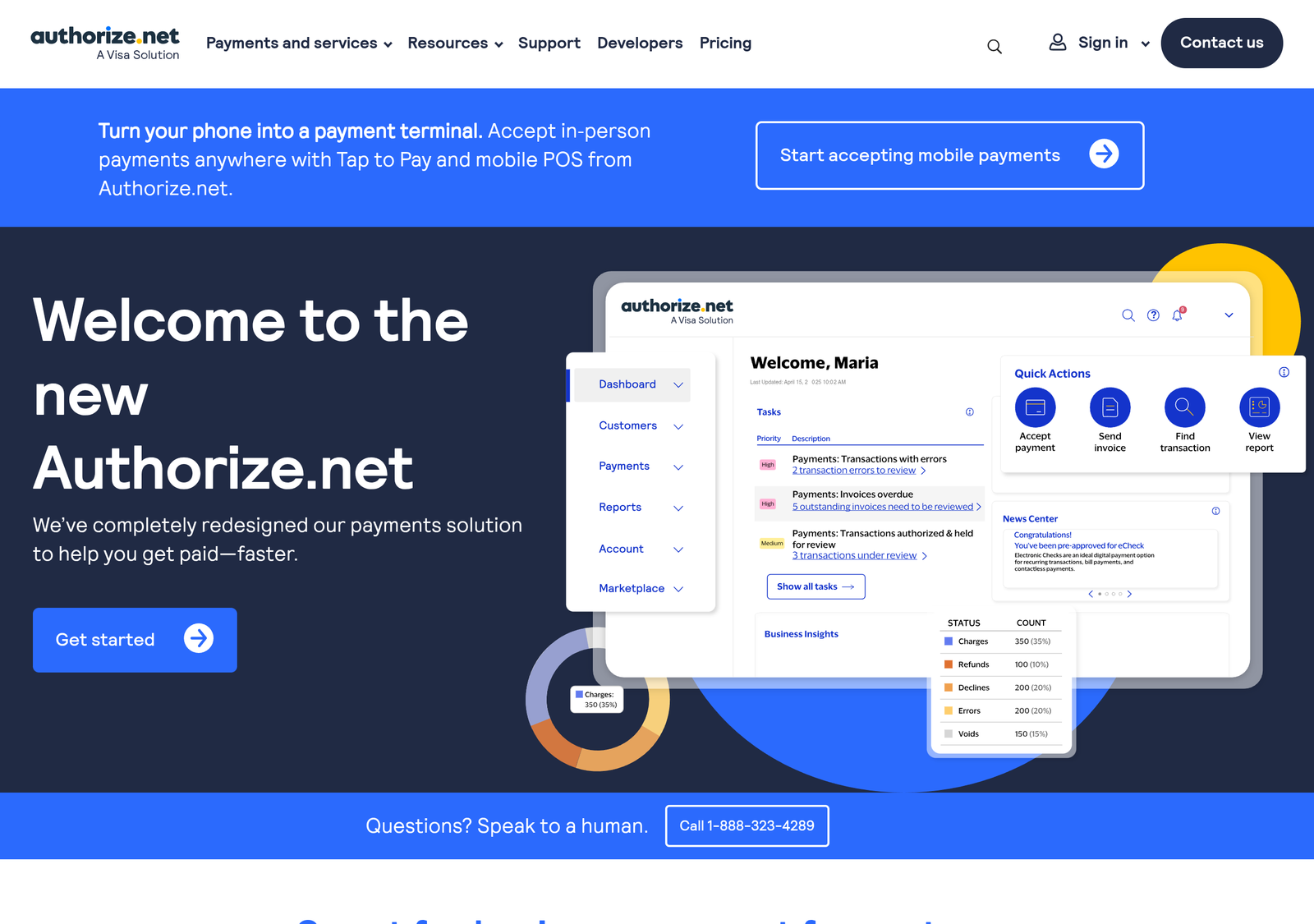
- All-in-One$25/mo + 2.9% + 30¢
- Gateway Only$25/mo + 10¢/txn
- Daily batch fee10¢
- eCheck0.75%
Authorize.net sells three plans, all with the same $25 monthly fee and no setup or termination charges. All-in-One bundles a merchant account for 2.9% + 30 cents a transaction. Gateway Only drops to 10 cents a transaction plus a 10-cent daily batch fee, but it requires you to already have a merchant account elsewhere — the gateway alone doesn't move money into your bank. Gateway + eCheck adds ACH processing at 0.75% per eCheck transaction.
That $25 fee applies whether you process one transaction or a thousand, which makes Authorize.net a poor first choice for a brand-new business with no existing merchant relationship. It earns its place with businesses that already have a merchant account and real volume, or that run on an older platform with a long-tested integration. Capterra rates it 4.5/5 across 215 reviews; Trustpilot sits at a rough 1.4/5, with real complaints about frozen funds. Full Authorize.net review.
2Checkout / Verifone
Pricing reported, not vendor-confirmedBroad reach, unconfirmed pricing

- 2Sell3.5% + 35¢
- 2Subscribe4.5% + 45¢
- 2Monetize (MoR)6% + 60¢
- New Aug 2026$500/mo, non-EU/US physical goods
2Checkout, now operating as Verifone, targets businesses selling digital goods or subscriptions to a genuinely international customer base, with broad local payment method coverage. Its three tiers are reported at 3.5% + 35 cents (2Sell), 4.5% + 45 cents (2Subscribe, adds recurring billing), and 6% + 60 cents (2Monetize, full Merchant of Record with global tax handling). We flag those figures as third-party reported rather than vendor-confirmed — the pricing page did not return accessible content when we checked it directly, unusual for a processor where published rates are normally table stakes.
The tier that matters most, 2Monetize, is directly comparable to Paddle: both sell Merchant of Record tax handling, and on the numbers available, Paddle's flat 5% + 50 cents undercuts 2Checkout's reported 6% + 60 cents for the same service. A new $500-a-month platform fee, announced August 2026, now applies to non-EU/US physical-goods merchants. Trustpilot's rating sits at 2.2/5 across more than 2,300 reviews, with reports of account terminations and held funds. Full 2Checkout review.
Paddle
Best Merchant of RecordMerchant of Record at one flat rate

- Rate5% + 50¢
- IncludesTax, VAT, fraud, chargebacks, billing
- Monthly feeNone
- ExceptionItems under $10
Paddle becomes the legal seller of record for your transactions, which means it handles global sales tax and VAT compliance rather than leaving that work to you. The price, verified directly against Paddle's own pricing page, is 5% + 50 cents per transaction, covering payment processing, tax remittance, fraud protection, chargeback handling and subscription management with no separate line items and no monthly fee.
That rate is roughly double what a standard processor like Stripe charges, and the gap is the price of the tax compliance work Paddle does for you. For a two-person SaaS team selling into a dozen countries, tracking and remitting VAT in-house is genuinely more expensive in time and audit risk than Paddle's premium. For a domestic-only seller, that premium buys nothing — a standard processor is simply cheaper. Items priced under $10, or accounts needing invoicing, fall outside the standard rate. G2 rates Paddle 4.7/5, though the FTC fined it $5 million over how it handled consumer chargeback complaints. Full Paddle review.
Getting Paid: The Tools in Detail
Wise
Best for clients who can pay by bank transferMoving and converting money at the real rate
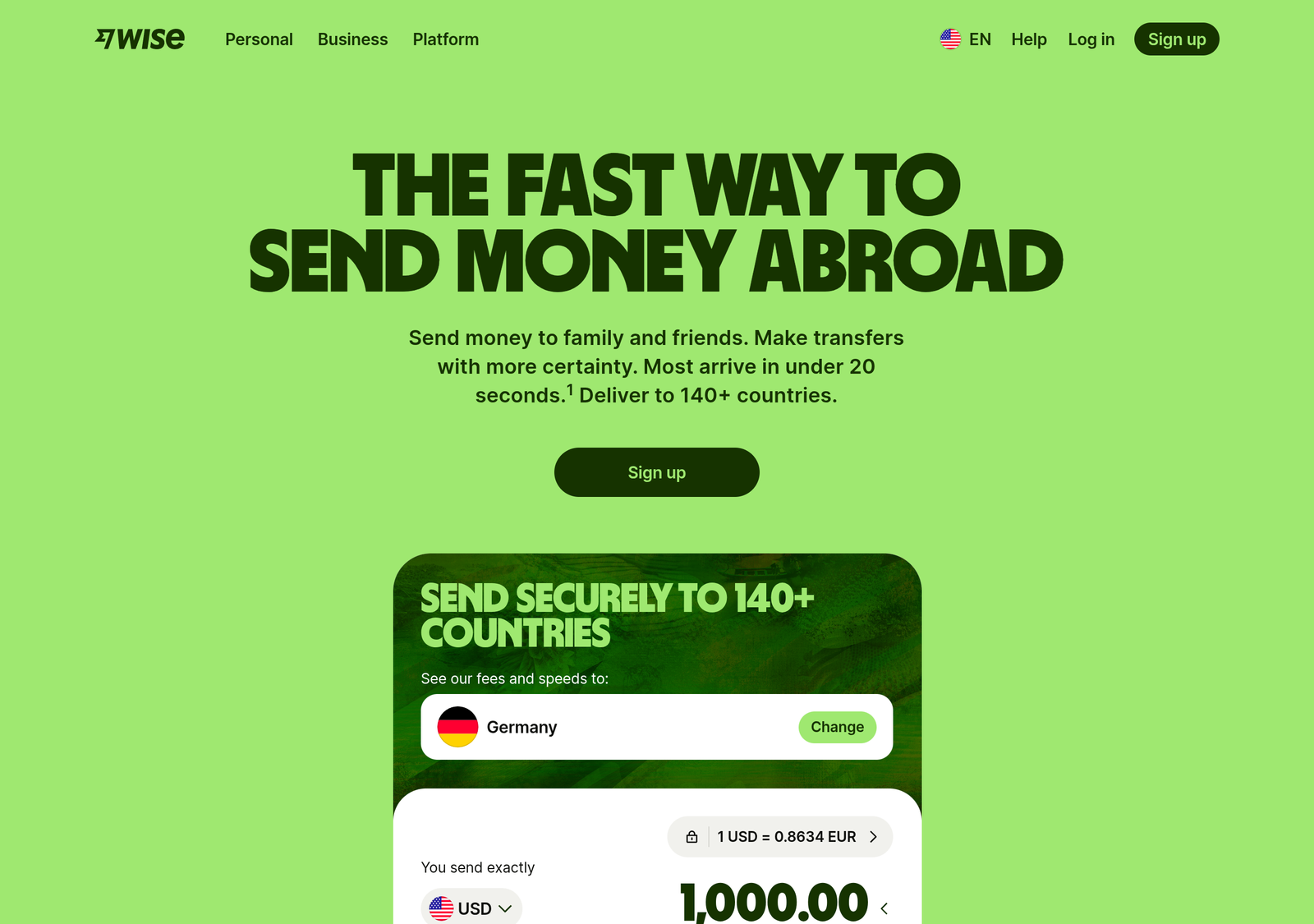
- FeeFrom 0.24%
- Exchange rateMid-market
- Account feeNone
- Local details20+ currencies
Wise converts currency at the mid-market rate — the actual midpoint rate you'd find searching a currency pair on Google — and charges a separate, stated fee starting from 0.24%, instead of burying a markup inside the exchange rate the way a bank does. The account is free with no monthly fee, and it gives free local receiving details in more than 20 currencies, so a US client pays what looks like a domestic transfer into your USD details while a European client does the same in EUR.
It is not a bank: funds are safeguarded rather than insured, and holding savings in Wise earns no meaningful yield. Its marketplace integrations are also limited compared to Payoneer — if a platform pays you out specifically through Payoneer, Wise doesn't change that. See our Wise vs Payoneer comparison for the full breakdown. Full Wise review.
Payoneer
Best when a marketplace requires itInfrastructure for marketplace payouts
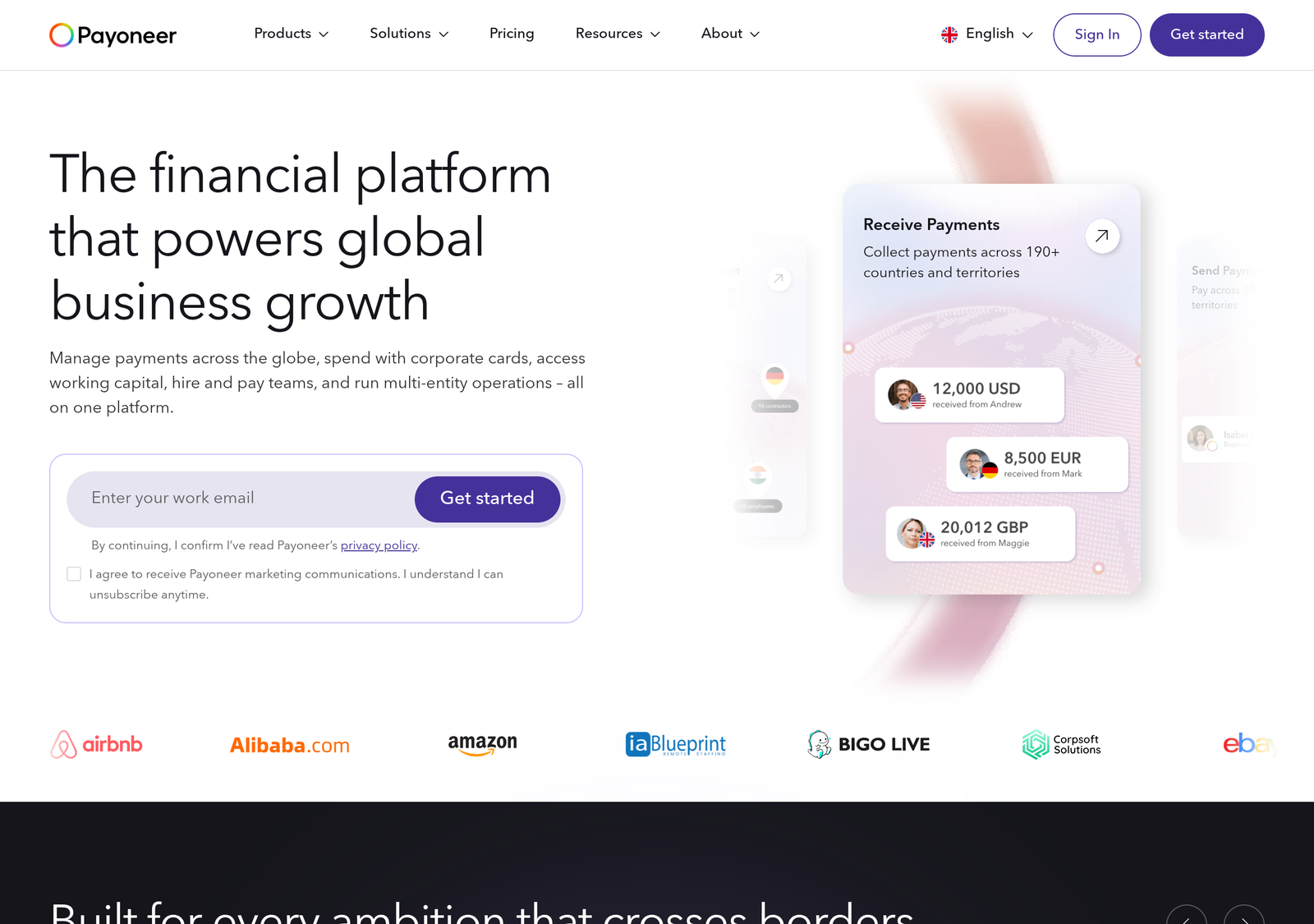
- Bank-transfer receivingAbout 1%
- Card payment requestsUp to 3.99% + 49¢
- Currency withdrawal1.2–4%
- Annual fee$29.95 if under $6,000
Payoneer solves a specific problem: getting paid when your clients or the marketplace you sell through can't easily send money to your country, or won't pay out any other way. Fiverr's payout system runs on Payoneer, and so does a large part of Upwork's — for freelancers on those platforms, it's not a choice among alternatives.
The cost is layered rather than singular. Receiving via bank transfer runs about 1%, credit card payment requests run up to 3.99% plus 49 cents, and withdrawing in a different currency costs 1.2% to 4% depending on the pair and country. An annual account fee of $29.95 applies if you receive under $6,000 equivalent in a year, so the fee lands hardest on the smallest earners. Used as a default currency converter rather than marketplace infrastructure, Payoneer is nearly always more expensive than Wise. Full Payoneer review.
PayPal
Only when a client insistsThe expensive way to be paid
- Invoiced payments3.49% + 49¢
- Currency conversion4%
Fees That Catch People Out
The headline rate is rarely the whole bill. These are the specific charges, each taken from the vendor's own pricing page:
- International cards and currency conversion. Stripe adds 1.5% for international cards and 1% when conversion is needed. PayPal charges 4% for currency conversion on purchases in another currency.
- Chargebacks and disputes. Stripe charges $15 per dispute, Braintree $15 per chargeback and PayPal lists $20. Helcim charges $15 only if you lose. The fee comes on top of the lost sale, so keep the rate low: see what actually reduces chargebacks.
- Manual entry. Square charges 3.5% + 15 cents for manually keyed or card-on-file payments, against 2.6% + 15 cents for tap, dip or swipe on the free plan.
- Third-party gateway penalty. On Shopify, choosing a gateway other than Shopify Payments adds 2%, 1% or 0.6% by plan.
- Fixed monthly fees. Authorize.net's $25 a month applies whether you process one payment or a thousand. 2Checkout announced a $500 monthly fee for non-EU/US physical-goods merchants in August 2026.
- Annual and account fees. Payoneer charges $29.95 a year if you receive under $6,000.
- Contract and termination terms. Helcim states that it has no contracts or termination fees. Some membership providers are reported to use multi-year agreements with early termination fees, so ask before signing.
- Held or reserved funds. Not a fee, but the most expensive surprise of all. See Payment Processor Holding Your Funds?
Before you sign up, ask one question in writing: what is my total monthly cost, including every fee? A good provider answers in one sentence.
Gateway, Processor, Merchant Account: What the Words Mean
- A payment gateway is the checkout connection. It securely captures the card details and passes them along. Authorize.net's Gateway Only plan is only this.
- A payment processor moves the transaction between the card networks, the customer's bank and your bank.
- A merchant account is the account at a bank or acquirer where card payments settle before they reach you. Stripe, Square, PayPal and Shopify Payments bundle this in: you sign up under the provider's own arrangement instead of applying for an account of your own. That is why signup is fast, and also why funds can be reviewed or held quickly.
- A Merchant of Record is the entity legally selling to your customer. Paddle and 2Checkout's top tier take that role, which is what lets them handle sales tax and VAT for you. Our guide to whether you need one covers the decision.
Video explainer from PaymentCloud, a company that sells merchant accounts, so treat any recommendations in it as theirs. The definitions are the useful part. Watch on YouTube.
How to Choose
- Collecting payment, or receiving it? Collecting from customers: Stripe, Square, PayPal, Helcim, Authorize.net, 2Checkout or Paddle. Receiving pay as a freelancer or contractor: Wise or Payoneer.
- Where do customers pay you? Mostly in person: Square or Helcim. Mostly online: Stripe or Helcim, or Shopify Payments if you run Shopify.
- Merchant with a merchant account already? Yes: Authorize.net's Gateway Only plan, at 10 cents a transaction, beats a percentage fee at real volume. No: a bundled processor like Stripe or Square, or a Merchant of Record.
- Merchant selling internationally, and want to own tax compliance yourself? No: Paddle's flat 5% + 50 cents undercuts 2Checkout's reported 2Monetize rate. Yes, or domestic-only: skip both and use a standard processor.
- How much do you process? Under about $10,000 a month, the flat-rate processors are easier and the saving from interchange-plus is small. Above that, run your numbers through the calculator, because a visible markup starts to matter.
- Getting paid: can clients pay you directly? Yes: Wise, for the mid-market rate and the lowest fees here. No, a marketplace requires a specific payout method: Payoneer, and treat its fee as the cost of being payable at all.
How to Switch Processors Without Breaking Your Checkout
- Open and get approved on the new account first. Do not touch the old one yet.
- List every place the old processor is wired in: checkout, invoices, subscriptions, refunds, webhooks and your accounting sync.
- Deal with stored cards early. Saved cards are tied to your old processor. Ask both providers about a PCI-compliant transfer of card data; without one, subscribers have to re-enter their cards.
- Run a small live test on the new system before moving anything real.
- Move new customers first and existing subscriptions last. Subscriptions are the risky part, because a failed migration means failed renewals.
- Keep the old account open for refunds and disputes. Chargebacks can arrive weeks or months after the sale, and you need the old account to answer them.
- Cancel last, after checking termination fees and confirming your final payout has arrived.
Frequently Asked Questions
Are Wise and Payoneer alternatives to Authorize.net or Paddle?
No. Wise and Payoneer solve getting paid as an individual or freelancer across borders; Authorize.net, 2Checkout and Paddle solve collecting card payments as a business. They don't compete for the same purchase, even though roundup pages routinely list all five together.
What's the actual difference between a payment gateway and a Merchant of Record?
A gateway like Authorize.net's Gateway Only plan moves the transaction but leaves you responsible for the merchant account and for calculating and remitting sales tax yourself. A Merchant of Record like Paddle legally becomes the seller and handles that tax compliance for you, in exchange for a higher per-transaction rate.
What is the cheapest way to accept card payments?
It depends on your volume, average order size and card mix. In the calculator's default case ($10,000 a month online, $80 average order, 2.0% card-network cost) Helcim's interchange-plus pricing cost about 17% less than Stripe. If your customers mostly use premium rewards cards, that gap narrows. Cheapest also excludes what a Merchant of Record does for you, so a lower rate is not automatically a better deal if you need tax handling.
How do Stripe, PayPal and Square compare on a $50 online sale?
Stripe charges $1.75 (2.9% + 30 cents). Square's free plan charges $1.95 online (3.3% + 30 cents). PayPal checkout charges about $2.24 (3.49% + 49 cents). On small orders the fixed fee does much of the damage, which is why PayPal's 49 cents hurts more than its percentage suggests.
Can I use more than one processor?
Yes, and many businesses do, most often a primary processor plus a PayPal button for shoppers who prefer it. The trade-off is two payout schedules and two sets of records to reconcile.
What does a chargeback cost?
Stripe charges $15 per dispute and Braintree $15 per chargeback; PayPal lists $20; Helcim charges $15 only when you lose. On top of the fee you lose the sale, and too many chargebacks can put the account at risk. Our guide on reducing chargebacks covers prevention.
Do I need a merchant account to use Authorize.net?
Only if you choose the Gateway Only or Gateway + eCheck plans, which pair with a merchant account you source separately. The All-in-One plan bundles one in for $25 a month plus 2.9% + 30 cents per transaction.
Is Paddle or 2Checkout cheaper for Merchant of Record services?
On the numbers available, Paddle's confirmed 5% + 50 cents is lower than 2Checkout's reported 6% + 60 cents for 2Monetize. 2Checkout's figures aren't confirmed against a live pricing page, so get a direct quote before deciding, but Paddle starts from a lower and better-verified position.
Should a freelancer use Wise or Payoneer?
Wise if clients can pay you directly by bank transfer; it's cheaper on conversion in nearly every case. Payoneer if a marketplace you earn on requires it. Many freelancers end up using both: Payoneer for platform income, Wise for everything else.
Why did 2Checkout add a $500 monthly fee?
Announced in August 2026, it applies specifically to non-EU/US merchants selling physical goods. Digital-goods sellers and EU/US-based businesses aren't affected, but it's a real new cost for the segment it targets; confirm directly rather than assume your account is exempt.
How We Assessed These
Every rate on this page comes from a vendor's own published pricing. Stripe, Square, PayPal, Helcim and Braintree were checked against their pricing pages on September 21, 2026; Authorize.net, Paddle, Wise and Payoneer were verified against their own pricing pages for the individual reviews. Shopify's rates come from its published processing-fees guide (January 2026) and pricing page. 2Checkout and Stax figures are third-party reported and are marked wherever they appear. We have not hands-on tested these processors, and we don't score all of them against one another with a single number, because they answer two different questions and a combined ranking would misrepresent that. Tools without a review link, such as Stripe, Square, PayPal and Helcim, are covered here from their pricing pages only. The calculator uses published rates and an assumed card-network cost that you can change; it is an estimate, not a quote. Disclosure: some links on this page may be affiliate links; that has no bearing on which tool is recommended for which job.
Related
- Authorize.net review · 2Checkout review · Paddle review
- Wise review · Payoneer review · Wise vs Payoneer, the full freelancer-payout comparison, not repeated here
- PayPal fees for freelancers · Do you need a Merchant of Record?
- Payment processor holding your funds? · Reducing chargebacks
- Best AI tools · Best web hosting